
Wellbeing Wednesday: Performance in the Age of the “Public Critic”
Welcome to Wellbeing Wednesday. Being deep in the trenches of “Evita” this week, I wanted to talk to the heart of our community: the performers.
Whether you are a singer, a community actor, a musician, or an artist, you live in a paradox. Your work requires you to be deeply vulnerable and open, yet you must do so in an arena where everyone feels entitled to an opinion. In the age of social media and instant feedback, the barrier between the stage and the spectator has vanished.
As a community artist, it can be soul-crushing to put months of technique, effort, and literal “blood, sweat, and tears” into a performance, only to have it critiqued by someone who has never stepped into the light.
How do we protect our wellbeing when our work is public-facing, and everyone is a critic?
1. Understanding the “Projection of Ignorance”
As a professional performer, you will have spent years honing your craft. You understand the nuances of breath control, the “why” behind a specific phrasing, and the sheer stamina it takes to stay present. As a community artist, maybe you haven’t been given that chance, this may even be a first time treading the boards, but the months of rehearsing and working incredibly hard are no different.
Always remember: many “critics” (and by this I mean, unofficial feedback, people sharing opinions without any little to no grounding or understanding of the industry, as opposed to official critics writing with understanding and knowledge) are speaking from a place of consumerism, not craft. They react to how something makes them feel in a split second, with little to no understanding of the technique required to get there.
- The Wellbeing Truth: Their critique is often a reflection of their own taste, not your talent. In psychology, it’s called “The Dunning-Kruger Effect”; where those with the least knowledge about a subject often speak with the most confidence.
- The Practice: When you hear a negative comment, mentally categorize it: “Is this professional feedback from someone who knows the craft, or is this ‘noise’ from a consumer?” If it’s noise, give yourself permission to let it pass through you like a distorted frequency.
2. Settling Into the “Safe Sonic Space”
How do you step onto the stage when you know eyes (and keyboards) are waiting? You have to build an Internal Sanctuary.
- The Music Therapy Hack: The Grounding Drone. Before you go on, spend three minutes listening to a single, steady drone or low-frequency hum, you can provide your own hum, or if in a dressing room with others, offer each other support with a gentle hum.
- Why it works: It pulls your focus away from the “external noise” of potential judgment and anchors you in your own physical vibration. You aren’t performing for them; you are inviting them to witness a moment of truth, a moment of light.
3. The “Positive Resonance” Filter
Sadly, negativity has a “velcro” effect; it sticks to us. Positive feedback, however, often feels like “teflon”; sliding right off. To stay amazing, you have to intentionally “glue” the positives to your spirit.
- The Practice: The 3-to-1 Ratio. For every critical comment you read or hear, you must actively find and write down three things you were proud of in that performance.
- The Goal: You are training your brain to prioritize Internal Validation over External Validation. Your wellbeing cannot be a hostage to the opinions of strangers.
4. Supporting Your Fellow Community Artists
The best way to block out the noise is to create a louder, more beautiful sound with your peers.
- The Ritual: After a show, don’t go straight to your phone. Spend 10 minutes with your fellow performers. Talk about the “micro-wins”; the note you finally hit, the way the lighting caught a moment, the shared energy.
- The Integration: This is part of your New Harmony. By focusing on the community of makers, the voices of the “ignorant critics” become background static.
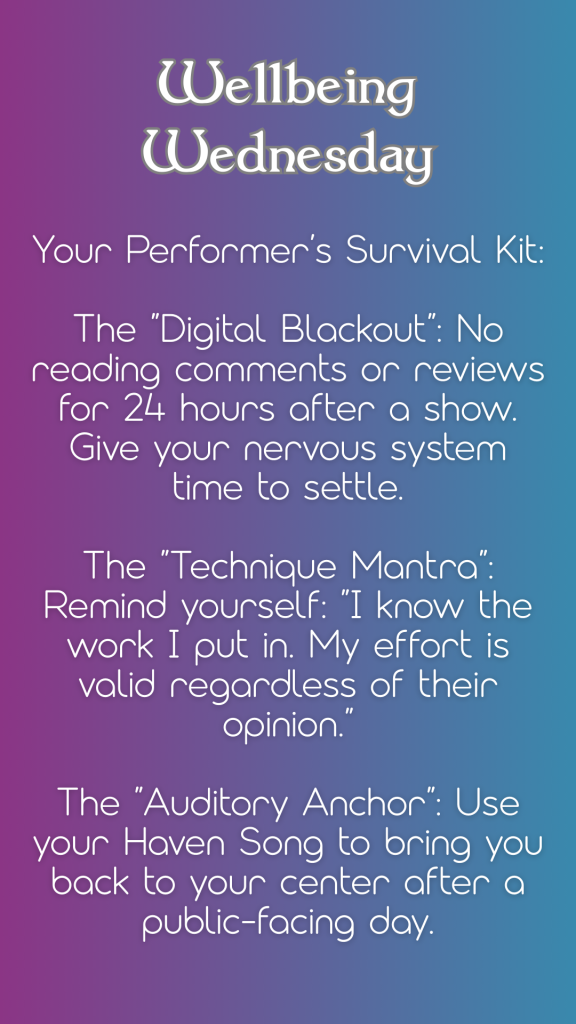
Performers, you are the amazing ones! You are the ones doing the work that others only watch. Keep making your art, keep using your voice, and remember: The person on the stage always shines brighter than the person in the stands.


You May Also Like

Wellbeing Wednesday: The Song of Agency. Finding Your Rhythm in Nature
Wellbeing Wednesday: Self-Care Glimmers