

-
Wellbeing Wednesday: The “Horcrux Effect”. Reclaiming the Pieces of Yourself When You’re Spread Too Thin
Welcome back to Wellbeing Wednesday. Today, I want to talk about a feeling that I know so many multi-passionate, hard-working people carry, but rarely have the words to describe.
If I am being completely transparent, this is where I have found myself lately. As a peripatetic music teacher across primary schools, a Musical Director for two theatrical societies and a choir, the director of a private music therapy practice, a mum, and a partner… my life is a tapestry of roles I truly love. But at times, I can feel a subtle, heavy phenomenon taking hold.
Let’s call it The Horcrux Effect. (I take no credit for this analogy; a dear friend of mine said it the other day, and it resonated so deeply that I wanted to share!)
For any Harry Potter fans out there, you’ll remember that a Horcrux is created when a soul is split into pieces and deposited into different objects across the world. Each piece lives independently, but the original source becomes diminished, fragile, and increasingly depleted.
When you wear five, six, or seven different “hats” every week, it can feel like you have left a literal piece of your soul in every classroom, every rehearsal hall, every therapy session, and every room of your home. Each place holds a piece of you, and each place draws energy directly from that piece. If you are lucky enough to have time out during the week or on the weekend, you may find you’re not just tired, you feel fundamentally diminished.
How do we survive when we feel like we’ve been split into too many fragments? How do we streamline our energy, protect our core, and keep ourselves whole?
1. Acknowledging the “Fragmented Soul”
The first step in dealing with the Horcrux Effect is dropping the “Superwoman” mask and acknowledging the sheer physical and emotional math of your life.
- The Reality Check: You are not a renewable battery with infinite capacity. Every time you step into your job, hold emotional space for someone else, present to other people, or listen to your family’s daily worries, you are actively giving away a piece of your emotional currency.
- The Reframe: Feeling diminished isn’t a sign that you are weak, disorganized, or failing (I often feel that I’m wrong or have failed in some way when people question my work or my choices). I try to look at it as proof that I am caring deeply in multiple directions at once. The math of the week is simply exceeding the daily energy budget.
2. The Art of “Energy Streamlining”
When every part of your life demands a different frequency, you cannot afford to waste energy on friction. We have to find ways to streamline our output without sacrificing the quality of our care.
- The “One-Sheet” Mental Prep: As a peripatetic teacher and MD, switching contexts five times a day creates massive cognitive fatigue. Try creating a strict “Zero-Friction System”: template lesson plans, standardised rehearsal warm-ups, and clear, repeatable boundaries. (Standardising warm-ups can actually be hugely beneficial; when warm-ups stay consistent for a while, my clients and casts can focus on physical sensations, releasing tension, sound placement, and articulation, rather than worrying about the notes they are singing!) Don’t reinvent the wheel every morning.
- The “Hat-Shedding” Ritual: When you leave any given job or event, create a physical boundary to mark the end of that role. Shaking out your hands, changing your shoes in the car, or taking a single deep breath before turning the ignition key signals to your brain: “I am taking that piece of myself back now.” I like to use certain styles of music to help “full stop” that moment of my day. My go-to for full-stopping, regulating, and energy-building for the next event is the music of Scary Pockets!
3. Sometimes, Acknowledgment IS the Answer
We live in a culture that demands solutions. When we express burnout, people immediately want to offer advice: “Just drop a job!” or “Just say no!” But when you love your work, when your therapy clients rely on you, and when your choir is counting on your baton, simply “quitting” isn’t realistic or, more importantly, desired.
- The Clinical Truth: Sometimes there isn’t a neat, magic answer. Sometimes the most therapeutic thing you can do is simply stop fighting the feeling, acknowledge the overload, and say out loud: “This is heavy right now, and it makes total sense that I feel diminished.”
- Offloading Where You Can: Look at the non-essential fragments. Can someone else fold the laundry this week? Can dinner be a pre-made meal? (I have a slow cooker obsession at the moment, and I’m proud of it!) Can an administrative email wait 48 hours? Offload the “logistical noise” so your remaining energy can go toward your core human needs.
Your Energy Preservation Toolkit:
- The “Core Soul” Sanctuary: Designate 15 minutes a week where you belong to nobody else. No pupils, no clients, no society members, no family. Sit in silence, listen to a favourite song, or drink a hot cup of tea without an agenda. Reconnect with the person who exists beneath all the titles …… and PUT IT IN YOUR DIARY!! Make it an acknowledged part of the day that cannot be filled up with anything else.
- The Unconditional Grace Reframe: Give yourself radical permission to offer 70% on days when you don’t have 100%. A 70% rehearsal or lesson led by a grounded, authentic you is infinitely better than a 100% performance powered by pure exhaustion.
- The Community Recall: Lean on your tribe. Let your societies, your partner, and your colleagues help carry the physical load of setup, clear-down, or admin. (Shout-out here to the Gelliswick Choir, who always set up the room for me… you don’t know how much that means!)
You cannot keep splitting your spirit into a dozen pieces without taking time to call those pieces home. Be gentle with yourself this week, acknowledge the heavy lift you are doing, and give yourself permission to preserve what is left for you.
-
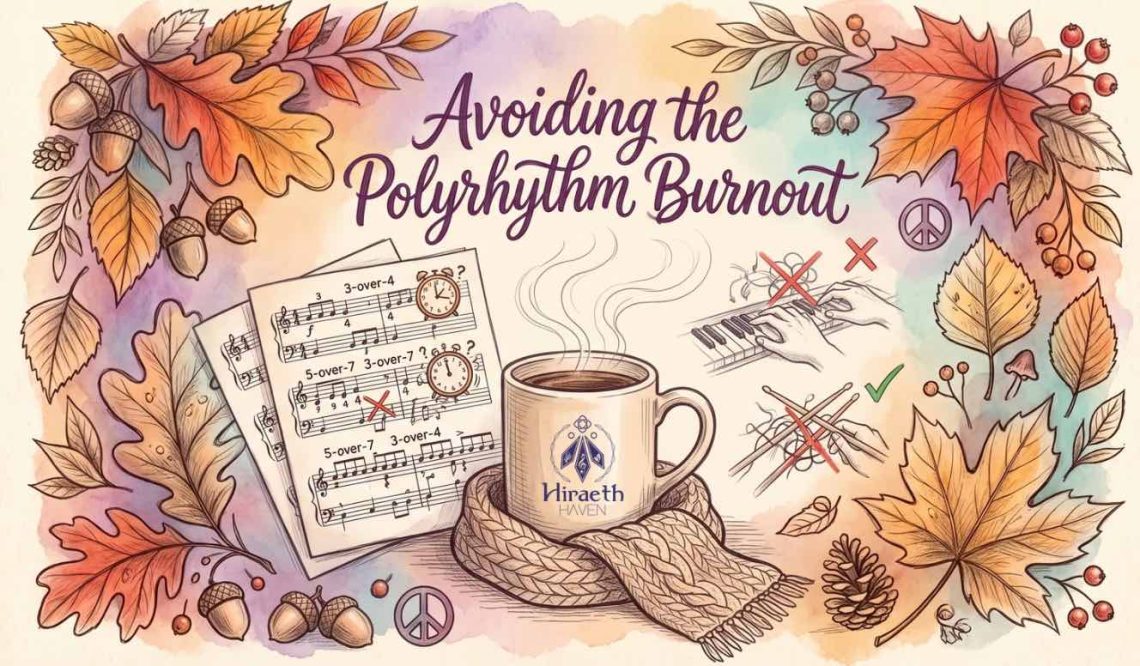
Wellbeing Wednesday: Taming the September “Polyrhythm” Burnout
Welcome back to Wellbeing Wednesday. As we settle deeper into September, I want to talk about a very specific type of exhaustion that I know so many of us are carrying right now.
If I am being completely transparent, this topic is hitting close to home this week. Between holding space for my therapy clients, managing my family’s needs as schools reset, fulfilling my responsibilities to my employer, teaching my singing pupils, and conducting for my musical societies along side battling with September illnesses, I have felt the weight of trying to be everything to everyone.
And then comes the end of the day. Stepping out of a full day of active, intent listening, walking into a home where others crave sound, music, or background audio to focus on their work. Suddenly, you are managing a sensory clash: one person’s focus engine is another person’s auditory overload.
If you are currently juggling a million competing expectations, feeling like every area of your life is demanding a different beat at the exact same time, you are not alone.
In music, there is a term for this: a Polyrhythm. And understanding it might just save your sanity this week.
1. What Is a “Human Polyrhythm”?
In musical theory, a polyrhythm occurs when two or more conflicting rhythms are played simultaneously: for example, tapping a steady 3-beat rhythm with your left hand while tapping a rapid 4-beat rhythm with your right.
To the listener, a polyrhythm can sound complex, rich, and thrilling. But to the musician playing it, it requires intense concentration, mental agility, and motor control. If your attention wavers for even a second, the entire rhythm collapses into chaos.
- The Working Parent Link: Right now, you are living a human polyrhythm. Your employer or clients expect a 4/4 corporate tempo. Your children need a gentle, patient 3/4 tempo. Your musical or community groups need a high-energy 6/8 tempo. And your household chores are humming along in the background like a relentless metronome.
- The Reality: Holding all of these conflicting beats at once isn’t just physically draining; it drains your cognitive budget. You aren’t struggling because you’re disorganised or “not doing enough”; you’re struggling because holding a polyrhythm for weeks on end is exhausting.
2. The Danger of “Tempos Clashing” (The Transition Melt)
The hardest part of a polyrhythm isn’t playing the notes, it’s shifting between the beats without stumbling.
For working parents and caregivers, the most dangerous moment of the day is the Transition Window: that 15-minute gap where you close your laptop, finish your therapy session, or step off the stage, and immediately step into “Parent Mode” or family logistics.
- The Problem: When you don’t give your brain time to change gears, the high-intensity tempo of your workday bleeds directly into your home life. You walk through the door with your nervous system still operating at maximum vigilance, making a simple request like “What’s for tea?” feel like an absolute crisis.
- The Practice: The “Micro-Pause” (The Fermata). In a musical score, a fermata is a symbol that indicates a pause; a moment where the tempo stops completely, and the music rests before moving to the next section.
- The Tool: You must build intentional “Fermatas” into your day. Before you step out of your car, open the front door, or greet your family after work, pause for two minutes. Close your eyes, place one hand on your heart, take three deep, 4-count breaths, and tell yourself: “That section of the day is finished. I am stepping into a new moment.”
3. Negotiating the “Sensory Clash” at Home
What happens when your polyrhythm hits a wall at home? After a full day of active, intent listening, your “listening tank” is at absolute zero. But what if your partner relies on background sound, TV, or music to stimulate their focus and process their day?
When auditory needs collide, it isn’t about preference, it’s about managing nervous system resources. Here is how to lower the household noise floor without starting a war:
- Create “Acoustic Zones”: Designate at least one room in your home as a Zero-Audio Sanctuary. No speakers, no TVs, no phone audio.
- Swap “High-Information” for “Low-Information” Sound: Speech, lyrics, and podcasts force an exhausted brain to keep processing language. Work together to swap lyric-heavy tracks for Brown Noise (a deep, soothing rumble like a waterfall), binaural beats, or gentle Lo-Fi instrumental tracks that stimulate focus without draining your remaining auditory budget.
- The “Listening Tank” Signal: Establish a simple, shame-free phrase like “My listening tank is at zero right now.” It signals to your partner that you need an immediate drop in open-air sound without them feeling criticised or rejected.
- The Headphone Sunset: Set a firm time in the evening where all open-air speakers are turned off, allowing the whole household’s soundscape to drop into a peaceful, low-frequency rhythm.
4. Take off the cape!
When we are overwhelmed, our default setting is often to put on our “Super Hero” cape and try to do everything ourselves. We think: “It’s faster if I just do it,” or “I can’t let anyone down.”
- The Reframe: Your job is not to play every note; your job is to guide the overall harmony of the home.
- The Strategy: Radical Delegation. Look at your daily polyrhythm. Where can you pass the baton? Can your partner or older children take over a household task? Can you say a graceful “Not this week” to an extra request?
- Apply Unconditional Positive Regard to Yourself: You are a human being, not a machine. Dropping a beat occasionally doesn’t make you a failure; it makes you human.
Your Polyrhythm Survival Toolkit:
- The 15-Minute Silence Buffer: Use high-attenuation earplugs or sit in a quiet room for 15 minutes before engaging with family noise after a long workday. Give your auditory cortex time to clear its processing queue.
- The “One-Beat” Focus: When you are with your pupils or clients, be 100% there. When you are with your children, be there. Stop trying to mentally play the “work rhythm” while sitting at the dinner table. One beat at a time.
- The Boundary Sunset: Set a firm time every evening where the “work window” is closed. No checking emails, no scheduling, no admin. The evening belongs to rest.
You do not have to conduct a flawless masterpiece every single day. Some days, simply keeping the pulse going is more than enough. Be gentle with your instrument this week, protect your pauses, and give yourself permission to drop the beats that don’t serve your peace.
Caption: “I feel like I’m trying to play three different songs at once.” 😅
If you’re currently juggling work, clients, family, school runs, and community
-
Wellbeing Wednesday: The Audition Aftermath.
Welcome back to Wellbeing Wednesday. As promised after my blog break, today I want to dive into a topic that lies right at the heart of my life as a performer, music therapist, and creative: The Audition Aftermath.
Whether you are stepping into a casting room for a musical, auditioning for a choir, interviewing for a job, or putting yourself on display in any high-stakes environment, the post-audition window can be an emotional minefield.
This month, I am stepping into the role of Musical Director again for both Saundersfoot Footlights and Milford Haven Amateur Operatic Society. We spent the weekend auditioning for the Christmas Panotmime at Footlights, and MHAOS are in preparation for Chitty Chitty Bang Bang auditions. Let me reassure everyone who is thinking about, or has, stepped foot into the room with us… Auditions are stressful for everyone. As a casting team, all we want to do is put together an amazing show; we are never looking for the negative in any performer.
The best analogy I can ever give was one I detailed for my own children last week. They wanted to know what auditions were… now there’s a concept to explain to a child! The best way I found was to align auditions with jigsaws (bear with me!)
Imagine you have four lovely jigsaw puzzles. Each has a different, inspiring, and enlightening picture on it, and each has a story to tell. But someone has unhelpfully mixed up all the pieces for these four jigsaws. In order to recreate the images, you have to sort these pieces. Some will fit together, and others won’t. It doesn’t mean those pieces aren’t perfect for their own picture; they just aren’t right for every picture.
So when you step into an audition room, try to remember: the panel isn’t judging you on how “good” you are. Who gives them the right to decide what’s good or bad anyway? Their job is simply to fit the pieces together for the specific story they want to create. It can be heartbreaking to give your all and not get the part you wanted, but it just means that for this story, this picture, you weren’t quite the right fit.
We know that you will have spent weeks preparing for and building yourself up to that brief moment in the spotlight. But the moment you walk out of that room, your mind can enter a turbulent space. If you feel it went badly, the “Public Critic” in your head starts shouting, threatening to drown you in self-doubt. If you feel it went brilliantly, the sudden spike of hope and excitement can leave your muscles tense, your mind racing, and your sleep disrupted.
How do we practice true self-care after an audition? How do we prevent negative feedback from breaking us down, and keep positive anticipation from creating physical tension?
1. Navigating the Negative: Stopping the “Dissonant Spiral”
If an audition felt rough (if you missed a high note, stumbled over a line… let’s be honest, who hasn’t done these things?!) your survival brain immediately enters a state of threat. You want to re-play the mistake a thousand times, trying to “fix” the past.
- The Music Therapy Link: The Clashing Chord. In a piece of music, a dissonant chord is meant to pass through to a resolution. But when we obsess over a bad audition, we hold onto that single clashing chord and refuse to let the piece resolve.
- The Practice: The “Data vs. Drama” Audit. Separate what actually happened from the story your ego is telling you.
- The Drama: “I ruined my chances forever; I am terrible at this.”
- The Data: “My voice was a bit thin on the top C, and the tempo was faster than I rehearsed.”
- The Reframe: Apply Unconditional Positive Regard to your effort. Treat yourself like a compassionate director would: “That was a tough room, but I brought my authentic self to the floor. The outcome does not define my worth.”
2. The Danger of the Positive: The “High-Tension” Hope
We rarely talk about how exhausting a good audition can be. When you nail the song and see the panel smiling, your system is flooded with dopamine and adrenaline.
- The Hidden Trap: Anticipatory Vigilance. You start checking your phone every two minutes. Your jaw clenches, your shoulders creep up to your ears, and your body stays in a state of high physical arousal waiting for “the call.” This positive tension can drain your “body budget” just as quickly as anxiety.
- The Practice: “Park the Performance.” The moment you cross the threshold of the building, the audition is officially over. It no longer belongs to you; it belongs to the casting team. Holding onto the hope too tightly creates physical constriction in your chest and throat.
- The Mantra: “I gave them my offer. Now I return to my own life.”
3. Re-Tuning the Body: The Post-Audition Decompression
Whether the audition felt like a disaster or a triumph, your nervous system requires a physical “De-Glow” ritual to return to a baseline of safety.
- The Exercise: The Vagal Grounding Reset.
- Wash it off: Go straight to a bathroom or home, wash your hands and face with cool water, and physically shake out your arms and legs.
- The Low-Vibe Breath: Sit quietly, place one hand on your belly and one hand on your chest. Take a 4-count inhale through your nose.
- The Grounding Hum: On an 8-count exhale, let out a low, warm, steady hum. Feel the vibration under your hand.
- Why it works: This physical vibration stimulates the Vagus Nerve, telling your brain that the “solo performance” is complete and it is safe to shift out of fight-or-flight and back into “Rest and Digest.”
Your Audition Self-Care Toolkit:
- The 24-Hour Rule: Give yourself a strict 24-hour hold on analysing the audition. If a thought about the room pops up, gently say, “We aren’t processing this today,” and redirect your focus.
- The “Non-Performance” Activity: Immediately after an audition, do something that has zero connection to your talent or career. Walk in nature (practice a bit of Acoustic Foraging!), cook a hearty meal, or play a silly game with your kids. Remind your brain of your life outside the spotlight.
- The “Haven” Playlist: Create a playlist of grounding, low-tempo instrumental tracks or familiar comfort songs that bring your internal tempo back down to a peaceful 60 BPM.
You are not a grade, a casting decision, or a panel’s opinion. No single audition has the power to ruin your story. There’s a beautiful, vibrant jigsaw that fits your piece, sometimes it just takes time to find it.
-
Wellbeing Wednesday: Navigating the September Shift: Back to School, Autumn Rain, and the “Ber” Months
It has been a loooong summer, but welcome back to Wellbeing Wednesday!!
I didn’t intend to take a summer break from the blog, but it happened, and it has been the best summer for understanding and embracing my own need for self-care (more about that next week!). So now that the summer holidays have drawn to a quiet close, schools are back in (parents… you made it!!!! Have yourself a cup of tea and a deep breath in and out!), and the weather has taken that familiar, unmistakable turn toward autumn rain.
We have officially arrived in the “Ber” months—September, October, November, and December.
This seasonal transition is one of the biggest “tempo changes” of the entire year. For our children, stepping back into the school routine brings a whirlwind of new teachers, bustling classrooms, and social expectations. For parents and caregivers, it means shifting gears from the expansive, unscheduled days of summer back into the relentless rhythm of alarm clocks, packed lunches, and rain-soaked school runs. And for those people not involved in education, it means the return of school run traffic jams and the rain! It’s here!
When the weather turns grey and the calendar fills up, it is completely normal to feel a mix of relief, exhaustion, and a low-level sense of overwhelm.
How do we support our children through the school transition, embrace the shift into the darker, rainy months, and keep ourselves in tune as the tempo of life speeds up?
1. The “After-School Restraint Collapse”
Have you noticed that your child comes home from the first few days of school looking fine on the surface, only to completely melt down over the wrong cup or a missing sock twenty minutes later?
In child psychology, this is known as After-School Restraint Collapse. Throughout the school day, your child’s nervous system is working overtime. They are holding in their emotional tension, sitting still, following rules, and navigating a loud, high-stimulus environment. When they finally walk through the front door, they reach their “Safe Haven”—and all that suppressed energy explodes.
- The Music Therapy Link: The Decompression Buffer. You cannot expect an instrument that has been played at maximum volume all day to suddenly be silent. It needs a gradual “fade out.”
- The Practice: The 30-Minute “Low-Noise” Window. When your children get home, resist the urge to immediately grill them with: “How was your day? What did you do? Who did you play with?” Instead, lower the noise floor. Provide a warm drink or snack, put on soft, low-frequency instrumental music or gentle nature sounds, and let them simply be in silence or quiet play.
- The Goal: Giving their nervous systems a chance to transition out of “school vigilance” and back into safety without having to process more questions.
2. Embracing the “Ber” Months: A Shift to Cosyness and Rest
When the summer sun fades and the rain starts hammering against the windows, it is easy to view the changing weather as a negative. But in wellbeing, the “Ber” months offer us a profound lesson in natural rhythms: Nature does not bloom all year round, and neither should you.
- The Reframe: From “Dreary Rain” to “Acoustic Sanctuary.” Rain carries a natural, biophilic frequency that acts as pink noise for the human brain. The steady, predictable patter of rain on glass or leaves naturally lowers our heart rate and signals to our nervous systems that it is time to slow down, gather inside, and rest.
- The Practice: Building Your Autumn Haven. Intentionally lean into the change of season. Bring out the warm blankets, light a candle, make a pot of soup, and create a cozy “sonic environment” at home. Swap the frantic summer outdoor energy for indoor warmth, soft lighting, and gentle background rhythms.
3. Re-Establishing the Family Pulse
A sudden change in routine can leave the whole household feeling a bit out of sync. When the mornings feel rushed and the evenings feel chaotic, we need a simple way to bring everyone back to a shared tempo.
- The Exercise: The Evening “Anchor Track.” Choose one relaxing, beautiful song to play at the same time every evening—perhaps while dinner is being served or right before the bedtime story routine begins.
- Why it works: Over time, your family’s nervous systems will connect that specific piece of music with safety, togetherness, and rest. It acts as an auditory signal that the demands of the day are over, helping children (and parents!) settle into a deeper, more restorative sleep.
Your September Shift Toolkit:
- The Rain Walk (Acoustic Foraging): Don’t let the wet weather trap you inside all week. Put on the wellies and raincoats, step outside, and leave the phones at home. Listen intentionally to the different sounds of the rain: how it taps on an umbrella, splashes in a puddle, or rustles through the autumn trees.
- The Parent’s “Pianissimo” Minute: After the morning school run, before you dive into work, household chores, or your to-do list, pause for 60 seconds. Sit in the quiet car or kitchen, place one hand on your chest, take a deep 4-count breath, and let out a long, low, gentle hum. Reset your own baseline before taking on the day.
- Radical Grace for Messy Tries: September is a transition month. There will be forgotten PE kits, tired tears, and days when you feel like you’re running behind. Give yourself and your children unconditional positive regard; you are all adapting to a new rhythm.
The summer sun may be setting, but the cosy, grounded warmth of the “Ber” months is here to welcome us home. Wrap yourself in the comfort of a slower evening tempo, listen to the rain, and let your family find its new, beautiful harmony.
-
Wellbeing Wednesday: The Silent Symphony of Pet Loss. Navigating the Dissonance of Companion Grief
Welcome back to Wellbeing Wednesday. Over the last few weeks, I’ve spent a lot of time talking about supporting ourselves through big life transitions, from the intense adrenaline crash of a theatre performance to the monumental identity shift of matrescence.
Today, I want to talk about a very specific, profound type of heartbreak that hits a completely different, deeply tender frequency: the grief of losing a pet.
Whether it is a sudden loss or the agonisingly slow decision to say goodbye at the vet, losing a companion animal leaves an immediate, echoing silence in a home; something that we are currently navigating in our own household. Yet, society often expects us to power through. We face the “Public Critic” or our own internal “Superwoman” whispering: “It was just a dog,” or “It was only a cat.” Indeed, I am so grateful to those people who have reached out in the last week and told me how helpful it was to hear me acknowledge my grief for our beloved dog. They had been feeling shame, or discomfort, at being so grief-stricken in similar circumstances and being told by those close to them to move on and “get over it.”
In my heart, I know that this grief is still grief. Whether a lost loved one was a family member, a friend, or a companion (and animals are so often all three), your grief is still grief. You are still mourning the loss of a loved one, and it is absolutely okay to acknowledge this and take the time that you need.
In my music therapy work and within trauma-informed care, we know there is no such thing as “just” an animal. Our pets are often the anchors of our daily rhythm. When that anchor is gone, our internal world can experience a massive, jarring upheaval.
How do we honor this unique grief, protect our well-being, and find a safe haven when our homes feel suddenly too quiet?
1. Acknowledging the “Disenfranchised Grief”
In psychology, losing a pet is often categorised as disenfranchised grief; a sorrow that society doesn’t fully validate or hold open space for. You rarely get compassionate leave from work for a pet, yet the emotional impact can be just as devastating as losing a human family member.
- The Music Therapy Link: The Missing Bass Note. A pet is the steady, grounding bass note of your daily routine. They dictate when you wake up, when you walk, and how you move through your kitchen. When that bass note is suddenly pulled out of the arrangement, the entire piece of music feels unstable and top-heavy.
- The Practice: Give yourself radical permission to weep. Do not apologise for the depth of your sadness. Use Unconditional Positive Regard on your own broken heart. Your grief is a direct reflection of the pure, uncomplicated love you shared.
2. Upgrading the “Empty Acoustic Environment”
One of the hardest parts of pet loss is the sudden change in the house’s soundscape. The missing click of claws on the floorboards, the absence of a collar jangling, or the silence where the “welcome home” bark (or, in our case, the frantic run to the door) used to be. This sudden drop in volume can feel incredibly heavy, triggering a low-level survival arousal because the environment feels “wrong.”
- The Strategy: The Sonic Comfort Bridge. Do not force yourself to sit in an uncomfortable, painful silence. Intentionally introduce gentle, low-frequency sounds to fill the space.
- The Practice: Play soft ambient piano, acoustic guitar, or Brown Noise (which sounds like a deep, distant waterfall) in the rooms where your pet used to sleep. This isn’t about forgetting them; it’s about providing a warm, sonic blanket for your nervous system while it adjusts to the new shape of your home.
3. Reclaiming the Rhythm of the Walk (Acoustic Foraging)
If you lost a dog, the loss of the daily walk can completely derail your well-being. Suddenly, you aren’t getting that vital daylight, movement, or sensory reset. But walking without them can feel incredibly lonely and raw. I’ve experienced waves of grief this week just walking to my office, because it is what I have done so many times before with her… without her, it feels wrong, and my heart hurts for a while.
- The Reframe: Walking for Your Instrument. If you can manage to step outside, try a practice called Acoustic Foraging. Leave the headphones at home. Walk a familiar path and intentionally listen to the environment. Notice the tempo of the wind through the leaves, the specific pitches of the birds, or the rhythm of your own footsteps.
- The Goal: Nature’s biophilic sounds naturally entrain our brainwaves to a calmer, slower frequency. It allows you to move the grief through your physical body rather than letting it stagnate in your chest.
Your Grief Integration Toolkit:
- The Creative Archive: Do not lock the memories away in fear of the pain. Write down their funniest habits, or print your favorite photo and place it in a dedicated spot. Turning your grief into a tangible memory anchors it as beautiful history.
- The Tactile Reset: When the wave of sorrow hits and your throat constricts, place your hand on your chest (where they used to rest their head or sit near you). Take a 4-count inhale, and let out a long, low, gentle hum. Let the physical vibration comfort your nervous system.
- Leaning on Your Tribe: Reach out to the people who “get it.” Tell your friends, “I’m really struggling with the quiet in the house today.” True community means having people who will sit in the quiet with you without trying to “fix” your sadness.
On a Personal Note:
I want to thank those people who have supported me in this past week, allowed me to feel sorrow, and supported me with empathy and kindness. It isn’t ever easy for any of us. We have had our fair share of people who haven’t acknowledged or supported our family at all, and that silence has added to the hurt. But the balance has been firmly tipped by an amazing community who have supported us and offered words of kindness and love. Thank you!
Our companion animals teach us so much about unconditional love, presence, and rhythm. Their lives may be shorter than ours, but the imprint they leave on our heart song is permanent. If you are experiencing a similar grief, please be incredibly gentle with yourself as you allow yourself the space to navigate this new normal. 🕊️🐾
-
Wellbeing Wednesday: Tuning Into “Matrescence”. Using Music to Navigate the Ultimate Identity Shift
Welcome back to Wellbeing Wednesday. Today, I want to talk about a word that isn’t used nearly enough, yet it describes one of the most seismic, earth-shattering transitions a human being can experience. That word is Matrescence.
Coined by anthropologist Dana Raphael and beautifully explored in Lucy Jones’ groundbreaking book Matrescence, it describes the deep physical, psychological, social, and emotional transition of becoming a mother. Lucy Jones writes about it not as a fleeting phase or a simple case of “the baby blues,” but as a total overhaul of the self; a developmental shift as massive, hormonal, and disorienting as adolescence.
During matrescence, the woman you used to be and the mother you are trying to become often clash. You are navigating an intense “Acoustic Overload” of crying, toys, and advice, all while grieving your old life (that deep sense of Hiraeth I often talk about here).
As a music therapist, a mum, and someone who intimately understands this transition, I want to explore how we can use music as a lifeline to support our mental health, protect our “body budget,” and find a safe haven within ourselves during this profound identity shift.
1. Music to Validate the “Split Self”
One of the core themes in Matrescence is the feeling of being split in two. You are fiercely protective of this new little life, yet desperately longing for your independent, uninterrupted old self. This internal conflict can make you feel incredibly guilty and isolated.
- The Music Therapy Link: The Dissonant Chord. In music, a dissonant chord contains notes that clash and create tension. It isn’t “bad” music; it is essential for creating depth, drama, and eventual resolution. Matrescence is inherently dissonant. You are allowed to feel deep love and deep exhaustion at the exact same time.
- The Practice: The “Two-Sided” Playlist. Create a personal playlist that bridges your two worlds. Include songs that remind you of your pre-motherhood identity (the songs you danced to, traveled to, or worked to) alongside songs that bring you peace in your new role.
- The Goal: Listening to your history reminds your nervous system that the melody of your life is still there. You haven’t vanished; your song is just expanding.
2. Upgrading Your “Acoustic Environment”
When you are in the thick of matrescence, your sensory boundaries are constantly breached. The baby is crying, the washing machine is humming, the toys are making electronic noises, and your internal critic is analyzing every move. This high-stimulus environment keeps your brain in a state of constant survival arousal.
- The Wellbeing Truth: You cannot always control the environment around you, but you can introduce a “buffer” to protect your instrument.
- The Practice: The Sonic De-Escalation. If the sensory overload is peaking, put in a single wireless headphone (leaving one ear open for safety) and play a low-frequency, lyric-free track—like gentle ambient piano or Green Noise (the sound of wind through trees).
- Why it works: By intentionally masking the chaotic frequencies of the room with a steady, predictable rhythm, you tell your vagus nerve that you are safe. It lowers your heart rate and prevents you from slipping into full “Superwoman” panic mode.
- An Extension to this may be to share this sound, pop it on for the rest of the family to hear too…. it may well be that they are seeking some safety too. Try using music like “Weightless” by Marconi Union, a track I have mentioned before and is associated with anxiety reduction.
3. The Power of the Shared Pulse: Community, Funding, and Safe Spaces
You cannot survive a planetary shift like matrescence on your own. Lucy Jones highlights how modern society isolates mothers, keeping them tucked away behind closed doors, expected to figure it out in silence. But human mothers were always meant to raise children in a village.
- Creating a Space to Share Freely: We desperately need spaces where the “public mask” can be dropped. A space where you can sit down, look another mother in the eyes, and say, “I am drowning today,” and be met with absolute validation instead of a critique. When we share our messy tries freely with others who truly understand, the heavy shame of not being “perfect” completely evaporates.
- Why Funding is Vital: True community support shouldn’t be a luxury available only to those who can afford expensive private classes. Securing funding for accessible maternal wellbeing groups, community music therapy sessions, and creative hubs is vital. I was lucky to recieve funding to start my Haven Songs Music Therapy group, but it now runs on a voluntary basis. But I am passionate to ensure that every caregiver, regardless of financial position, has access to a Safe Haven where she can find her tribe.
- The Music Therapy Link: Common Ground. In a group setting, music acts as the ultimate equalizer. When mothers gather to sing, hum, or play instruments together, their nervous systems physically synchronize. You don’t have to explain your burnout to the room; your shared pulse speaks for you. At the end of our therapy session we also allow time for a cuppa and a chat, a chance to share your fears, thoughts, feelings with other caregivers who can understand and empathise with you. It is a space made for caregivers to unburden, regulate and connect.
4. Reclaiming Agency Through the “Vocal Cradle”
Lucy Jones talks about how mothers are often viewed merely as vessels or caregivers, losing their own agency in the process. Singing or vocalizing is one of the quickest, zero-cost ways to reclaim your body as yours.
- The Exercise: The Mother’s Humming Reset. When holding your baby, or even when you finally get a moment alone in the bathroom, place one hand on your chest. Take a deep, 4-count breath into your belly, and let out a long, low, gentle hum on the exhale.
- The Clinical Science: The physical vibration of humming stimulates the vagus nerve in your throat and chest, physically forcing your body out of fight-or-flight and into a state of “Rest and Digest.” Beautifully, if you are holding your baby, they will feel that physical vibration too, co-regulating both of your nervous systems simultaneously.
Your Matrescence Wellbeing Toolkit:
- The “Me” Track: Listen to just one song today that has absolutely nothing to do with children or parenting. Listen to it purely because it feeds your soul.
- The Space Check: Look for funded or local community-led creative groups in your area this week. Reaching out to a shared space is an investment in your mental health. And if you are Pembrokeshire based and would like to join the Haven Songs Therapy group, please do drop me a message, you will be very welcome. 😀
- The Collective Hum: If you have a friend who is also navigating motherhood, skip the tidy coffee shop date. Sit in the living room, put your phones away, and just let the kids play while you two talk honestly, warts and all.
Becoming a parent is a profound re-tuning of your entire being. Give yourself the unconditional grace to navigate this transition one note at a time, and remember, you were never meant to sing this song alone, you can find a tribe that will welcome and share this journey with you.
-
Wellbeing Wednesday: The Power of the Sounding Board. Finding a Tribe That Guarantees Safe Passage
Welcome back to Wellbeing Wednesday. Today, I want to pull back the curtain on a specific part of my professional life that has recently got me thinking deeply about how we manage our personal wellbeing.
As a newly qualified music therapist, teacher and theatre creative, my week involves a lot of emotional output. To ensure that my own instrument doesn’t crack under the weight of holding space for others, I have a therapeutic supervisor.
For those who haven’t encountered supervision, it isn’t management, and it certainly isn’t an inspection. My supervisor is not there to critique me, score my performance, or tell me where I’ve “failed.” Instead, they act as a clinical sounding board; a safe, objective harbour where I can lay down the messy tangles of the week, bounce ideas around, and be gently guided toward other ways of thinking.
It made me realize that this shouldn’t just be a luxury reserved for clinical training. We all need a supervisor for our lives. We all need a tribe, or even just that one person, who acts not as a critic, but as a compassionate guide for our mental health. (in honesty, I have an army of those people in my phone, who listen to my voice note rants regularly and offer their support whenever they can. I may not have them in person always, but they live in my phone!)
1. The Danger of the “Internal Echo Chamber”
When we try to navigate stress, career decisions, parenting, or big life changes entirely in our own heads, we create an internal echo chamber. Our worries bounce off the walls of our mind, amplifying until a tiny problem sounds like a deafening crisis.
- The Music Therapy Link: Acoustic Mud. If you play a loud chord in a room with terrible acoustics and no dampening, the sound reflections bleed into each other until it just becomes a muddy, chaotic wall of noise. You lose the clarity of the individual notes…… some would say, “build a drum screen” (iykyk…. and now I know who has read this one ;))
- The Tribal Solution: A true sounding board acts as the acoustic treatment for your mind. When you speak your thoughts out loud to someone who meets you with Unconditional Positive Regard, the “mud” clears. They help you separate the signal from the noise.
2. Not Critique, But “Reframing”
There is a massive difference between a critic and a supervisor. A critic tells you what you did wrong based on their standards. A therapeutic supervisor looks at the map with you and says, “Let’s look at this chord from a different angle. What happens if we try a different rhythm here?”
- The Practice: Finding Your “Guaranteed Safe Passage” Person. Look at your current circle. Your tribe shouldn’t be filled with “yes-men,” nor should it be filled with critics. You are looking for people who offer a Safe Haven for your unpolished, half-formed thoughts.
- The Reframing Power: When you say, “I feel like I’m failing as Superwoman this week,” a true tribe member doesn’t judge. They guide your perspective: “Or maybe you’re just a human who has reached her capacity, and it’s time to switch off.”
3. The Relief of “Unloading the Counter-Transference”
In therapy, we talk about counter-transference—the way we unconsciously absorb and carry the emotional energy, anxieties, and moods of the people we care for. If you are a mother, a teacher, or a business owner, you are absorbing emotional energy all day long.
- The Integration: You cannot store everyone else’s emotional data without a designated place to download it. A supervisory relationship, whether professional or a deeply trusted friendship, is a dedicated space where you are legally and emotionally allowed to say, “This is heavy. Help me unpack it.”
- The Goal: To step out of the echo chamber, re-tune your perspective, and walk back into your world with absolute clarity.
Your “Sounding Board” Toolkit:
- The Explicit Ask: The next time you need to vent to your partner or a friend, set the stage explicitly: “I don’t need you to fix this or critique me. I just need you to be my sounding board while I figure it out out loud.”
- The Collaborative Sync: Dedicate a 15-minute “coffee catch-up” with a trusted peer this week purely to bounce ideas around with zero judgment.
- The “Other Perspective” Reframe: When stuck on a problem, consciously ask yourself: “How would my life-supervisor look at this right now?”
You don’t have to conduct your life in total isolation. Reach out to your tribe, find your sounding board, and let someone else help you find the harmony when the noise gets a little too loud.
-
Wellbeing Wednesday: The Under-16 Social Media Ban. Navigating the Shift from “Mars” Back to Earth
Welcome back to Wellbeing Wednesday. Today, we need to talk about a massive, historic shift that is currently happening across the UK, one that is causing an audible sigh of relief from some caregivers and a wave of panic from others. I’m talking about the UK’s new social media ban for under-16s.
If you’ve been reading this blog for a while, you’ll know how much a brilliant analogy from The Anxious Generation by Jonathan Haidt resonates with me. He compares the invention of the smartphone-led childhood to jettisoning our kids to Mars: unaccompanied, unexplored, and unprepared. For years, parents have been blamed for their teenagers’ online behavior, completely forgetting that we were the ones sent to Mars first, completely unguided ourselves!
I don’t know if this is anyone’s “fault” as such; this genie came out of the bottle and far exceeded what we all thought it would do. But now, we need, for our own and our children’s well-being, to take back control, which can be a very scary and daunting thought.
With this new legislation, the UK is finally trying to bring the next generation back down to Earth. From a clinical, music therapy, and developmental perspective, this is a monumental moment for maternal and adolescent wellbeing. I have seen and heard many opinions on the subject, and I am not here to judge nor condemn. What I would like to do is offer support through this transition and offer alternatives. If they work for you, brilliant.
So, what if your loved one is already on “Mars”? What if they already have multiple active accounts, and you are now tasked with managing the fallout of this massive digital boundary?
1. Why This Matters for Teen Wellbeing: Lowering the “Vigilance Frequency”
For a teenager, social media isn’t just an app; it’s a constant, high-frequency thrum of social feedback. Their developing nervous systems are exposed 24/7 to the algorithms of comparison, FOMO (Fear Of Missing Out), and quantified popularity (likes, views, follower counts).
- The Music Therapy Link: The Over-Amplified Feedback Loop. Imagine an electric guitar placed too close to its amplifier. It creates a piercing, painful screech of feedback that grows louder and more destructive the longer it sits there. Social media does the same to a teen’s brain. It keeps them in a state of “low-level vigilance”—subconsciously waiting for the next notification, even when they sleep.
- The Benefit of the Ban: By removing legal access to these apps, we are lowering the societal “noise floor.” It gives their brains a chance to step away from the feedback loop and settle into a healthier, more natural emotional rhythm.
2. Remind Your Loved One: This IS NOT a Ban on Connection
We know that social media can feel like a lifeline to some young people; it can feel like the only place where they can be seen and accepted. But what is important to remember here is that this is not a ban on communication. Mobile phones will still be allowed. You can still message, video call, email, text, and WhatsApp (so far, this isn’t included in the ban list). There are still infinite ways to communicate with your tribe; we just need to reframe our expectations of how this will happen.
3. The Great “Withdrawal”: Managing the Shift If They Already Have Accounts
If your child is under 16 and already has TikTok, Instagram, or Snapchat, this ban isn’t just a policy change; it’s going to feel like a cultural eviction. For a teenager, asking them to delete their accounts can feel like asking them to stop breathing. How do we navigate this transition without starting a household war?
- The “Shared Disappointment” Harmony: Don’t position yourself as the executioner. Frame it as a collective, nationwide shift. Validate their anger and sadness with Unconditional Positive Regard. You can say: “I know this feels incredibly unfair, and I know you’re going to miss your online spaces. It’s okay to be angry about it.”
- The “Lead by Example” Solo: This is our golden opportunity as parents to look at our own usage. If we are telling our under-16s they can’t be on apps while we are glued to our own doom-scroll at the dinner table, the harmony is broken. Let them see you putting boundaries on your own tech.
- The “Grown-Up” Alternative: If they lose their social media, replace it with something tangible. Upgrade their “Acoustic Environment.” Work together to find a creative hobby, a sports club, or, as I talked about last week, a creative passion like music, drama, or art. We have to give them something to run toward, not just something taken away.
4. Reclaiming “Real-Life Resonance”
Historically, human connection was built on Synchrony—singing together, playing games, sitting face-to-face, and reading body language. Social media offers a filtered, artificial version of connection that strips away all the raw, beautiful reality of human interaction.
- The Strategy: The Shared House Pulse. Use this legislative shift to reset your home’s Safe Haven. Re-introduce the “Charging Station” in the kitchen where all devices go to sleep at night. Dedicate phone-free zones for family meals where you can practice active, present listening.
- The Goal: To help our children realize that their internal song is worth hearing based on who they are in the real world, not how many likes they get from strangers on a screen.
Your Tech Shift Toolkit:
- The “It’s the Law” Reframe: Use the policy as your shield. It takes the pressure off you being the “bad guy” and places it on a collective health decision.
- The Creative Bridge: Re-introduce non-connected audio devices (like older MP3 players or CD players) if they used social media apps for background music or sleep sounds.
- The “Real-World” Glimmer: Actively schedule face-to-face time with their friends (sleepovers, movie nights, or trips out) to replace the digital connection they are losing.
This transition isn’t going to be easy. There will be slamming doors, eye-rolls, and a lot of emotional static. But remember: drawing a line at the digital border is a brave act of love. We are bringing our kids back from Mars, and we are helping them find their footing on solid, authentic ground.
-
Wellbeing Wednesday: Feeding the Soul. The Vital Importance of Embracing Your Creative Passion
Welcome back to Wellbeing Wednesday. Today, I want to talk about a part of our health that often gets pushed to the absolute bottom of the to-do list: our creativity. When life gets busy, the family schedule is packed, the world goes crazy, or the financial climate is loud, our creative passions are usually the first things we sacrifice. We tell ourselves that painting, singing, writing, acting, or picking up an instrument are “luxuries” we don’t have time for. We fall into the trap of thinking that if an activity doesn’t produce an income or cross an item off our chore list, it isn’t a productive use of our energy.
But as a music therapist and a theatre creative, I am here to tell you that embracing your creative passion isn’t an indulgence. It is essential maintenance for your soul. When you abandon your creative outlets, you aren’t just saving time; you are starving your authentic self.
I am very guilty of this. While I “create” every single day in my jobs, rarely do I let go and create purely for me, for my own soul.
I was spurred on to write this blog after my gig on Saturday night, where I got to sing my own arrangements just to entertain and feed my creative side. I always come alive during a gig and remember why I need my music. And I don’t say this lightly: I NEED IT. I need it to feed my soul, to remind me why I’m me, and to connect to an internal voice who, when I lose touch with her, limits my ability to love and care for myself in a very big way.
So, sitting down to write this today, I recorded this song. I intentionally made time to sit and record not only the piano and vocals, but to get my clarinet out, something I don’t do much anymore, which makes my soul sad. This recording was a half-hour’s work, tops. There is very little studio magic here; just one and a half run-throughs and away we go. It’s not perfect. It’s not going to set the world alight! There are missed pitches, dodgy recording moments, and the timing is rough, but it’s exactly how I felt today.
I adore the lyrics in this song, so I thought, why not? Creating for me, creating a song I never sing professionally, and bringing back my clarinet. Love it or hate it, I am putting it here for you to hear me, warts and all.
1. Creativity as a “Release Valve” for Stress
We swallow a lot of emotional tension throughout the week. We manage difficult conversations, handle unexpected bills, and hold space for everyone else’s worries. If that emotional energy has nowhere to go, it sits in our bodies as structural tension—tight shoulders, a clenched jaw, and an exhausted mind.
- The Music Therapy Link: The Creative Outlet. In therapy, we don’t look at creative expression as a way to make “perfect art.” We look at it as a form of non-verbal processing. Creativity is a safe highway for complex emotions to leave the body.
- The Practice: Give yourself five minutes today to engage in your passion completely free from expectations. If you love to sing, blast a track in the car and sing with zero regard for how “good” it sounds. If you love to paint, scribble colors on paper without worrying about the final image.
- The Goal: To move from “bottling up” your emotions to letting them flow.
2. Stepping into the “Flow State” (Your Mental Haven)
Have you ever been so lost in a creative project—whether it’s sewing, playing a piece on the piano, baking, or gardening—that you completely lost track of time? In psychology, this is known as the “Flow State.”
- The Science: When you are in a state of flow, your brain’s “Default Mode Network” (the part responsible for overthinking, worrying, and self-criticism) goes quiet. Your brain waves shift into an alpha or theta rhythm, which mimics deep meditation.
- Why it matters: Creativity is one of the few ways we can actively force our over-analytical, “Superwoman” brains to take a seat. It creates a portable, internal Haven where the demands of the outside world simply cannot reach you.
3. Reclaiming Identity Beyond Your “Roles”
It is incredibly easy to lose ourselves in our daily titles. We become “Mum,” “Teacher,” “Employee,” or “Caregiver.” We spend our lives performing these roles for the people around us.
- The Reconnection: Your creative passion is a direct line back to your Authentic Self. It reminds you of who you are when you aren’t serving anyone else. It honors your personal history, your unique perspective, and your individual voice.
- The Truth: When you protect your creative time, you are teaching your children, your partner, and yourself a powerful lesson: My joy matters. My inner world is worth cultivating.
Your Creative Wellbeing Toolkit:
- The “Messy Tries” Permission: Banish the “Public Critic.” Dedicate time to your passion where the goal is simply to play, fail beautifully, and enjoy the process.
- The Sonic Switch: If you can’t physically paint or write today, use music to spark your imagination. Close your eyes for three minutes and let a beautiful piece of instrumental music build a movie in your mind.
- The Tribe Share: Share your passion with someone else. Sing in a community choir, join an amateur dramatics group, or simply show a friend a poem you wrote. Connection multiplies creative joy.
You do not need to be a professional artist to live a creative life. You are the composer of your own wellbeing, and your heart song deserves to be heard. Put down the chore list for just a few moments this week, pick up your “instrument,” whatever it may be, and let yourself play.
Don’t ever be frightened to be creative, be authentic, be you!
-
Wellbeing Wednesday: Managing the “Post-Show Blues”; Grounding Your Nervous System After the Curtain Falls
Welcome back to Wellbeing Wednesday. If you were with me last week, you’ll know my world was operating at a beautifully intense frequency as the Musical Director for Saundersfoot Footlights’ production of Made in Dagenham.
Much to our general disappointment, the show is now firmly packed away, and the hall has returned to its usual state. But if you’ve ever been involved in a show, or even if you’ve sat in the audience and been deeply moved by a powerful performance, you know exactly what happens next.
The quiet arrives, and with it comes a sudden, heavy drop in emotional energy. In the theater world, we call it the “Post-Show Blues.” In music therapy, we look at this not as an emotional failing, but as a predictable physiological comedown. When you spend days or weeks living in high-intensity emotion, adrenaline, and shared connection, your nervous system takes a massive hit when it suddenly stops.
So then, how can we care for ourselves when the spotlight fades and the “post-show silence” feels a bit too loud?
1. Understanding the “Adrenaline Crash”
Whether you were part of the company creating the show, or someone gripped by the story from row J, a powerful performance floods your system with cortisol, adrenaline, and dopamine. Your brain is firing on all cylinders, deeply connected to a collective pulse.
- The Music Therapy Link: The Decrescendo Drop. In a musical score, a decrescendo is a gradual fading of sound. But this post-show blues feel less like a gradual fade and more like a sudden, jarring silence. Your body goes into a state of “withdrawal” from the emotional high, leaving you feeling empty, run-down, or unexplainably tearful.
- The Practice: Give your body permission to crash. The fatigue you feel isn’t just laziness; it is your nervous system begging for a re-balance. Treat yourself with the same Unconditional Positive Regard you’d give a tired child. Allow yourself to feel and process these changes—some may even say you can embrace them for the memories of what you achieved.
2. Transitioning from the “Public Harmony” to Your Inner Haven
Onstage or in a packed auditorium, your personal identity blends into a shared community experience. Coming back home to the laundry, the routine, and the bills can feel incredibly grounding, but also incredibly cold.
- The Danger: Trying to immediately force yourself back into “Superwoman” mode (yep, I know, that’s me!) before you’ve processed the emotional output.
- The Practice: The “De-Glow” Routine. Create a physical ritual to signal to your brain that the performance is officially over. Wash off theater makeup slowly, warm down your body and voice, take a long shower, or change into your most comfortable clothes. As you do, intentionally think: “The show is done. I am returning to my quiet haven.”
3. Re-Tuning Your Mind with a “Sonic Bridge”
When a show ends, we often make the mistake of trying to fill the void by immediately seeking out the next high, or conversely, wallowing in total silence. Instead, we need a “bridge” to bring us gently back to earth.
- The Exercise: The 3-Step Low-Vibe Reset. 1. Breathe: Sit quietly in your favorite chair, place both hands on your belly, and take a 4-count inhale. 2. Sound: On the exhale, let out a very low, gentle, sighing hum. Don’t make it powerful or theatrical; make it soft, internal, and comforting. 3. Listen: Put on an instrumental track that has a slow, steady tempo (around 60 BPM), like acoustic guitar or gentle piano. Let your breathing slow down to match the music.
- Why it works: This process allows your heart rate and brainwaves to gently entrain to a slower, safer rhythm, pulling you out of the leftover “performance vigilance” and guiding you back into “Rest and Digest.”
Your Post-Show Wellbeing Toolkit:
- The Creative Archive: If you were in the cast, write down your favorite memories or funny backstage moments in a journal. Don’t let them float away as sad nostalgia; anchor them as beautiful history. If you were part of the Dagenham experience, feel free to comment below with your memories, and we’ll make this an online archive of what we achieved!
- The Gentle Hydration: Adrenaline dehydrates the body and tightens the throat muscles. Drink warm herbal tea to soothe your physical instrument.
- The Next Glimmer: Don’t look for the next “big stage.” Look for a tiny, zero-cost glimmer in your normal routine today—the way the birds sound in your garden, or a quiet cup of tea in a phone-free room.
Sharing electric, transcendent stories is a gift, but the silence that follows is where the integration happens. The curtain has come down, the applause has ended, and that is exactly as it should be. You played your part beautifully. Now, let yourself rest.