
Wellbeing Wednesday: Finding the Bravery of “No”
Welcome back to Wellbeing Wednesday… and if I’m honest, it’s not a great one for me. With a virus that isn’t shifting, I am very run down and fighting the internal battle between the need to work and the desperate need to rest. (I know, we’ve been here before)
So today, I’m tackling one of the most difficult “compositions” to write: The Boundary.
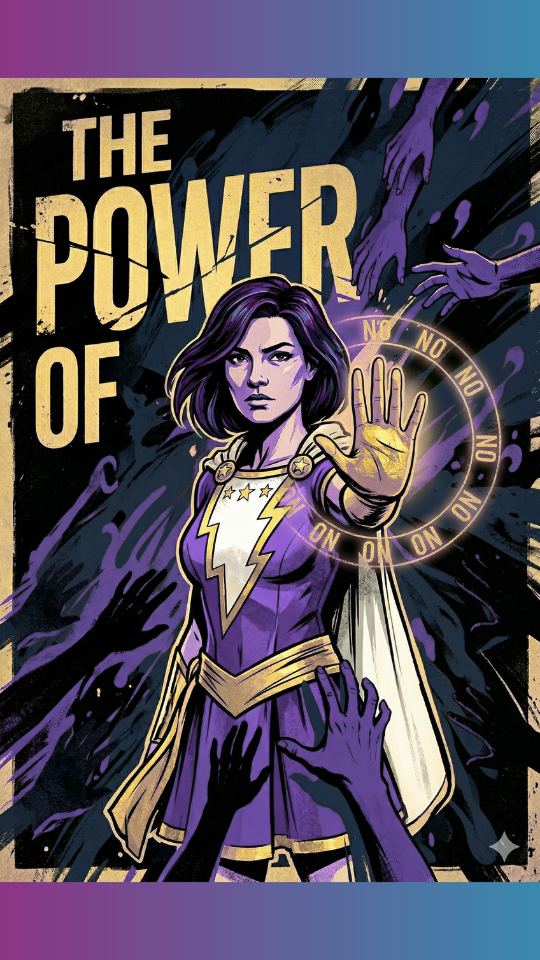
For many of us, especially those in the caring professions, the arts, or the freelance world, our entire lives have been a masterclass in saying “Yes.” We were praised for being “helpful,” rewarded for being “flexible,” and taught that our value is directly tied to our availability to others. If you are like me, this is so ingrained that even when you understand it intellectually, you still struggle to break out of it. Some days I feel like I need to embrace my inner “Mary Marvel”, the superhero who can come out and say ‘No!’ with the kind of power that actually changes the atmosphere.
When you add the pressure of being freelance, the message becomes even louder: “Say yes to every gig, every favor, and every extra hour, or the work will disappear.” But living a life of “Yes” when your body and soul are screaming “No” isn’t being helpful; it’s self-abandonment. Today, I’m thinking about how to be brave, how to stop people-pleasing, and how to use music therapy to help find that elusive, life-saving “No.”
1. The Anatomy of a “People-Pleaser”
People-pleasing isn’t just “being nice.” It’s a survival strategy, often rooted in a fear of conflict or a deep-seated belief that our needs are secondary to everyone else’s.
- The Wellbeing Truth: Every time you say “Yes” to someone else when you want to say “No,” you are taking a loan out against your own mental health; and the interest rates are high. Burnout is simply the point where you can no longer pay that debt.
- The Music Therapy Link: The “Dissonant” Chord. When you say “Yes” but feel “No,” your internal harmony is disrupted. You are living in a state of cognitive dissonance, which creates physical tension in the jaw, neck, and chest.
2. The Freelance Trap: “Scarcity vs. Sovereignty”
As a freelancer or community artist, “No” feels like a risk. We fear that saying no to one project means we’re saying no to all future projects.
- The Reframe: Saying “No” to the wrong things is the only way to have the space and energy to say a resounding “Yes” to the right things.
- The Practice: The 24-Hour Buffer. Never say yes on the spot. Use a standard script: “Thank you so much for thinking of me. Let me check my capacity and get back to you by tomorrow.” This creates a “sonic pause”, a space where you can listen to your own needs away from the “noise” of the solicitor’s expectations.
3. Finding Your “Tonal No”
Sometimes, we find it hard to say “No” because we don’t know what it feels like in our bodies. We can use sound to practice the physical sensation of a boundary.
- The Practice: The Staccato Breath. In music, staccato means short, detached, and clear.
- The Exercise: Practice making a sharp “Ttt” or “Kkk” sound. Feel the way your core muscles engage to stop the air. This is the physical “stop” your body needs to feel.
- The Humming Boundary: If you’re struggling with a decision, hum a low, steady note. If the request makes that note waver or feel tight, your body is saying “No.” Trust the vibration.
4. The Bravery of Being “Disappointing”
Here is the hardest truth: When you start saying “No,” some people will be disappointed. They might even be annoyed. This is a feeling I struggle with deeply at times like this; how do you not disappoint people? Well, the short answer is: You don’t.
- The Integration: Their disappointment is not your responsibility. You are a professional, not a 24-hour convenience store. Real wellbeing is the ability to sit with the discomfort of someone else’s disappointment while knowing you are being true to yourself.
- The “Power Track”: Pick a song that makes you feel “Solid.” Not aggressive, just immovable. Play it before you have a difficult conversation. Let that music be the “spine” that helps you stand tall.
Your “No” Toolkit (One I am trying very hard to use myself):
- The Script: “I’m unable to take this on right now, but thank you for the opportunity.” (No explanation needed; “No” is a complete sentence, let your “Mary Marvel” out).
- The “Sonic Pause”: Give yourself overnight to decide.
- The Body-Check: If the “Yes” feels like a heavy weight in your stomach, it’s a “No.”
Being brave doesn’t mean you aren’t scared to say no. It means you value your own “New Harmony” more than you fear their reaction.
I’m off to practice what I preach and get some rest. I hope you can find a way to honour your own “No” this week, too.


You May Also Like
Wellbeing Wednesday: Navigating the Exam Season Symphony

Wellbeing Wednesday: Self-Care Glimmers