-
Wellbeing Wednesday: Self-Care Glimmers
Welcome back to Wellbeing Wednesday. This week, I’ve been thinking about a tribe of people who often feel like they are living two full lives at once: the working caregivers, a tribe I’m proud to be part of 😉
Whether you are navigating a 9-to-5, managing a team, or running your own business while simultaneously caring for children, an aging parent, or a loved one with a disability, you are essentially working two full-time jobs. In this reality, “self-care” often feels like just another item on an impossible to-do list…… my list grows exponentially, day by day.
When your identity is split between being a “Professional” and a “Caregiver,” your own mental health is usually the first thing to be sacrificed. This week I wanted to shift the focus from big self-care to Self-Care Glimmers.
The Weight of the “Invisible Shift”
Working caregivers often finish a grueling day only to start their “second shift” of caregiving immediately. There is no commute to decompress, no clear boundary, and often, little realisation or time to process the mental load you are carrying.
But the goal isn’t to “fix” your schedule, it’s to find glimmers of peace within it.
1. What are “Glimmers”?
In psychology, while “triggers” spark distress, glimmers are tiny micro-moments that spark a sense of safety or joy. For a working caregiver, a glimmer is much more sustainable than a weekend away.
- The Practice: Look for 10-second windows. The way the light hits your morning coffee. The feeling of fresh air during a 30-second walk to the bin. A specific lyric in a song that makes you feel like you again.
- The Rule: You must actively acknowledge it. Say to yourself: “This moment is for me.” This simple act of recognition tells your nervous system that you are more than just a provider or an employee; you are a person who deserves rest.
2. The “Sound-Bath” Transition
The hardest part of being a working caregiver is the “context switching”—moving from a high-stakes meeting to a high-needs caregiving situation.
- The Practice: Use music as a sensory airlock. Before you close your laptop or step out of the office, put on headphones and listen to one specific song.
- Why it works: This creates a mental boundary. It allows the “Work Self” to settle before the “Caregiver Self” takes over. It prevents the stress of the deadline from bleeding into the stress of the dinner hour.
3. Radical Self-Compassion in the Chaos
We often feel like we are failing at both roles because we can’t give 100% to either.
- The Tip: Practice Radical Realism. If you had a difficult day at work and the house is a mess, or if the caregiving demands meant you didn’t get through your inbox, try to acknowledge the sheer volume of what you are managing.
- The Mantra: “I am doing the work of two people, and ‘good enough’ is a massive achievement today.” Letting go of the “perfection” of either role is the ultimate act of self-care.
4. Humming for Internal Regulation
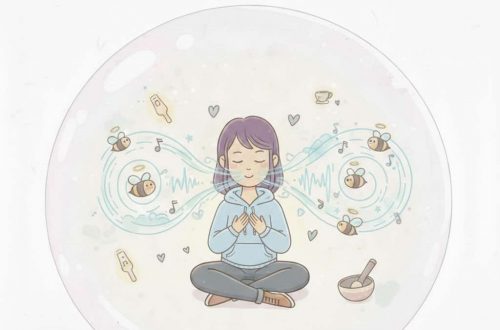
Caregiving and professional stress both cause us to hold our breath. Humming is your “portable reset button.” (One that I will be touching on a little more next week)
- The Practice: While you are multitasking, whether that is prepping a meal or waiting for a meeting to start, hum.
- The Science: The vibration of humming stimulates the vagus nerve. It lowers your heart rate and reminds your body that it isn’t in a state of emergency, even when the to-do list says otherwise.
Your Working Caregiver Survival Kit:
- The “Glimmer” Anchor: Find one tiny thing each day that is just for you. Acknowledge it.
- The Transition Track: A song that helps you switch gears between roles.
- The Lowered Bar: Permission to leave the non-essentials (the laundry, the extra emails) until tomorrow.
You are the engine that keeps so many lives running. But remember: an engine needs maintenance to keep going. Acknowledging your own needs isn’t selfish; it’s what makes your work and your care possible.
What were your glimmers today? Writing them down can help to acknowledge and embrace them
-
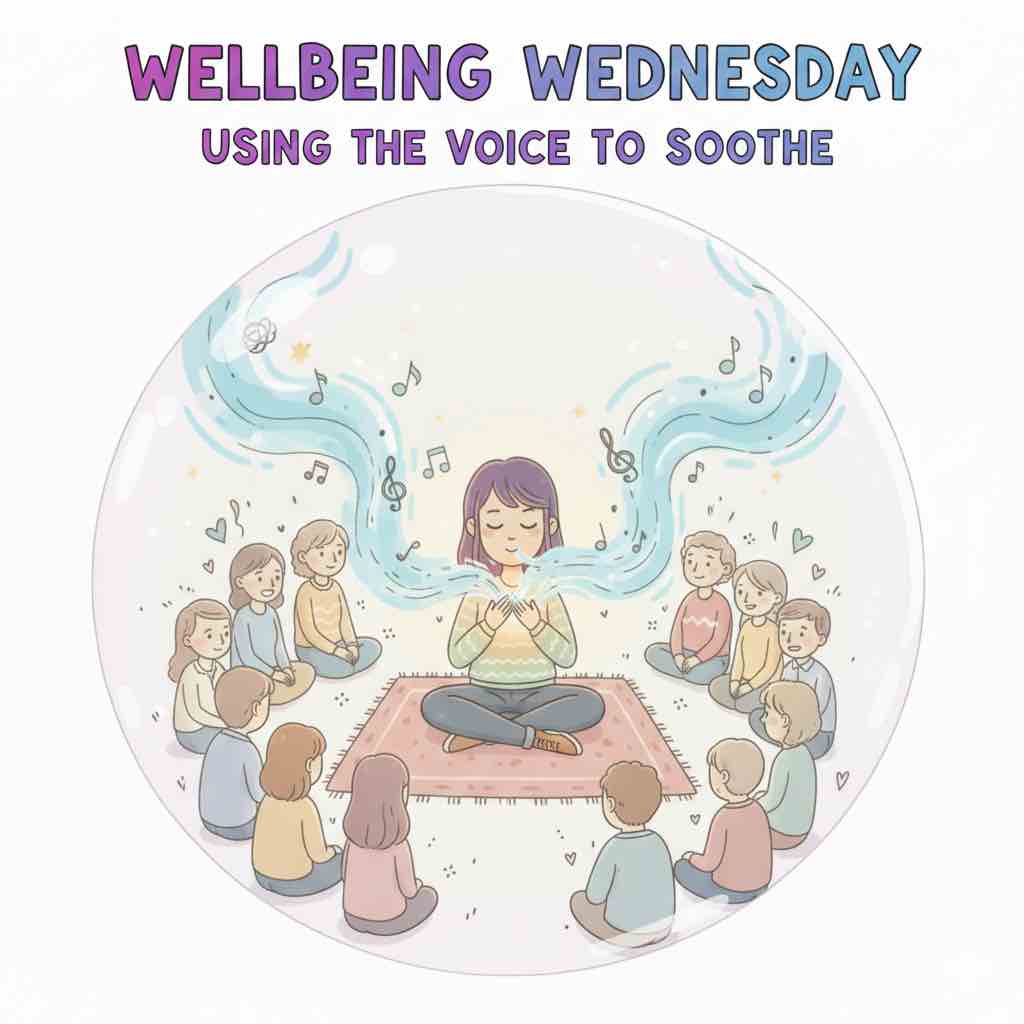
Wellbeing Wednesday: The Sound of Safety. Using Music and Voice to Soothe Through “Ouch” Moments
Welcome back to Wellbeing Wednesday. This blog is aimed a little more at new caregivers with young children, but I wonder if it would be impactful for all of us? Have a read and let me know your thoughts.
For new caregivers, the first year is a whirlwind of milestones, but there is one recurring event that often brings a heavy dose of “parental guilt” and anxiety: vaccination appointments.
Watching your little one experience pain, even when it’s for their own protection, is incredibly stressful. When a baby or toddler is distressed, our own “fight or flight” response kicks in, often making us tense up, which the baby then mirrors….. an ever increasing negative cycle that I’m sure we’ve all been in, I certainly have.
Today, I thought I would focus on how your voice and music could act as a powerful “auditory hug,” creating a shield of safety during vaccinations or other painful procedures. It is something that I researched during my Masters, but also something that I am hugely passionate about and we cover in the Haven Songs therapy group.
1. The Power of the “Mother-Tune” (Vocal Presence)
You are your child’s primary source of regulation. Your voice is the most familiar, comforting sound in their world. Long before they understand words, they understand prosody, the rhythm and melody of your speech.
- The Wellbeing Hack: During any procedures, don’t just talk; sing-song. Use a low, melodic, and repetitive tone. This “infant-directed speech” (sometimes called Parentese) naturally lowers a baby’s heart rate and cortisol levels.
- The Practice: Choose a simple lullaby or a song you sang frequently while pregnant. Start singing it before the needle happens, so the “safety signal” is already established when the “ouch” occurs, maybe in the waiting area? I am sure that anyone who looks at you at this point will only be smiling and you’ll be spreading a warm hug throughout the space, just with your vocal presence… it may make someone else’s day!
2. Humming for Co-Regulation
If you are holding your baby during their appointment, your physical vibrations are just as important as the sound.
- The Practice: Hold your baby skin-to-skin or chest-to-chest and hum into the top of their head or against their back, perfect if you are seated for the vaccination with baby on your knees, you can lean them back so their back is leaning on your body. * The Science: The vibration of your chest wall acts like a literal massage for the baby’s nervous system. It stimulates their vagus nerve via your humming. This is called co-regulation: you are using your calm state to pull them out of their distressed state.
3. The “Post-Ouch” Harmony
The moments immediately following a vaccination are the most important for “repairing” the sense of safety.
- The Practice: Don’t stop the music the second the needle is out. Continue the melody or the hum for several minutes as you cuddle them. This signals to the baby that the “threat” has passed and they are back in the “Safe Zone.”
Your “Ouch Day” Sound Kit:
- The “Safety Song”: A familiar lullaby they know from home.
- Your Own Breath: Remember to breathe deeply. If you hold your breath, your voice will sound tight, and your baby will feel your tension.
Vaccinations are a small moment of pain for a lifetime of protection. By using music, you aren’t just soothing their cries; you are teaching their nervous system that even when things hurt, they are safe, heard, and held in harmony….. and you will, no doubt, bring this sense of calm and pleasure to those around you, making the day of everyone you see!
It can feel inhibiting to use your voice in these environments, but gentle humming can make the world of difference.
Let me know if you have tried humming to calm and reset your, or your little ones, nervous system, I’d love to hear your experiences.
-
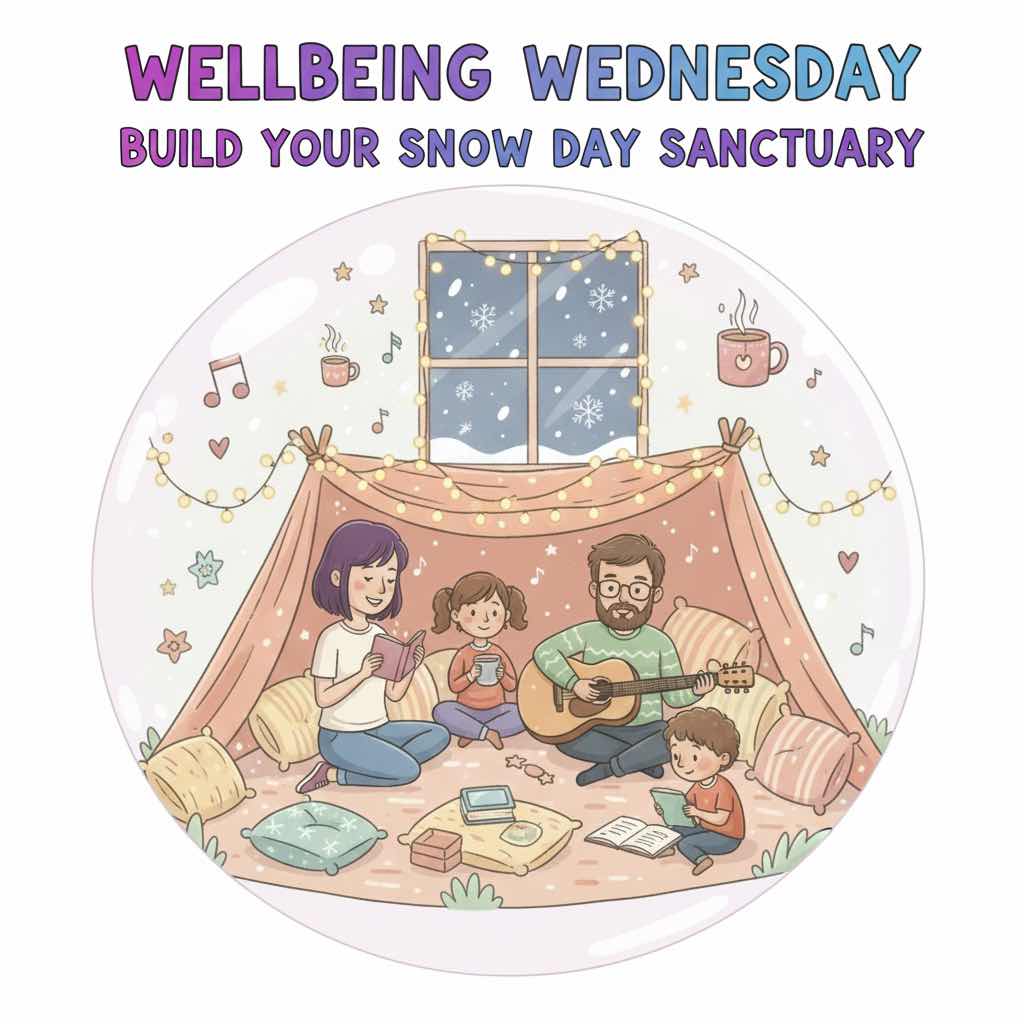
Wellbeing Wednesday: The Snowed-In Sanctuary Trying to Find Your Rhythm When the World Stops
Welcome back to Wellbeing Wednesday. Over the last week, nature has hit the “pause” button for many of us. With the snow and ice closing schools and another storm on the way, the initial “winter wonderland” magic can quickly turn into a sense of isolation, cabin fever, or even anxiety.
When we are snowed in, our sense of control vanishes. We can’t get out easily, go to work, see our “village,” and our routines are buried under the drifts. Today, I wanted to look at how we could use music as a tool for internal stability when the external world is frozen.
1. Breaking the “Static” of Cabin Fever
When you are stuck inside for days, the air can start to feel “heavy.” The silence of the snow outside can make the noises inside, the hum of the fridge, the ticking clock, feel amplified and irritating.
- The Music Fix: Use music to change the “molecular structure” of your room. If the energy feels stagnant, put on something with a strong, driving rhythm. You don’t have to dance (though it helps!), but just having a steady beat in the background provides a “pulse” for your day when the world outside feels motionless.
- The Practice: Create a “Motion” playlist. When you feel the cabin fever rising, put it on and let the rhythm move the air around you.
2. Vocal Warmth: The Internal Fire
Being cold isn’t just a physical sensation; it can affect our mood, making us feel retracted and small. As we’ve discussed before, your voice is a portable heater.
- The Science: Singing and humming increase your heart rate and circulation. More importantly, tit can aid in releasing tension that we naturally hold when we are shivering or stressed.
- The Practice: If the heating is struggling or the weather is howling, sing. It doesn’t have to be a masterpiece. Sing a familiar childhood song or a folk tune. The physical act of producing sound creates a sense of “space” and warmth inside your body that no radiator can match.
3. The “Soundtrack of Resilience”
Being snowed in can be scary, especially if you’re worried about power or supplies. During these times, our “fight or flight” response is on a low simmer.
- The Music Fix: Music is a powerful anchor to the “Before and After.” Listening to music that you associate with strength, summer, or safety reminds your nervous system that this storm is temporary.
- The Practice: Choose an album that reminds you of a time you felt powerful and capable. Let it play from start to finish. It serves as a reminder that you have weathered storms before and will again.
Snow-Day Wellbeing Kit for Adults:
- One “Upbeat” Album: To break the stagnation.
- One “Calm” Album: To soothe the anxiety of the storm.
- A Hot Drink & A Hum: To keep the internal temperature up.
The “Indoor Blizzard”: Parenting, Schooling, and Working in the Mess
And for those parents, like me, who have felt the impact of school closures, impending work deadlines, increased workload and the general trials of work/life/parenting balance…… our wellbeing may depend on Radical Realism.
- Lower the Bar (Then Lower it Again): If the kids are safe, fed, and relatively happy, you are winning. This is not the week for “perfect” homeschooling or a showroom-clean house.
- The “Musical Transition” Trick: It is impossible to switch your brain from “Spreadsheet Mode” to “Mom Mode” instantly. Use music as your bridge. When you finish a work block, play one high-energy song and have a 3-minute family “dance break.” It resets the kids’ energy and signals to your brain that the work-cap is off.
- Shared Rhythms, Not Strict Schedules: Instead of a rigid schedule, find a shared rhythm. Use a low-fi “Focus” playlist for everyone, kids colour or do their worksheets while you type. The shared auditory environment creates a sense of “we’re in this together” rather than “everyone is in my way.”
- Sing! Make time to vocalise together, even if it is just humming along with your playlist, connecting through the voice can ground you and connect you in a magical way.
The Golden Rule for the Snowed-In Parent: You cannot be everything to everyone at 100% capacity right now. Be the “Good Enough” parent, the “Good Enough” employee, and the “Good Enough” housekeeper. Your sanity is the most important thing for your family to get through the storm.
Stay safe, stay warm, and remember: the snow may have stopped the world, but it hasn’t stopped your song!!
-
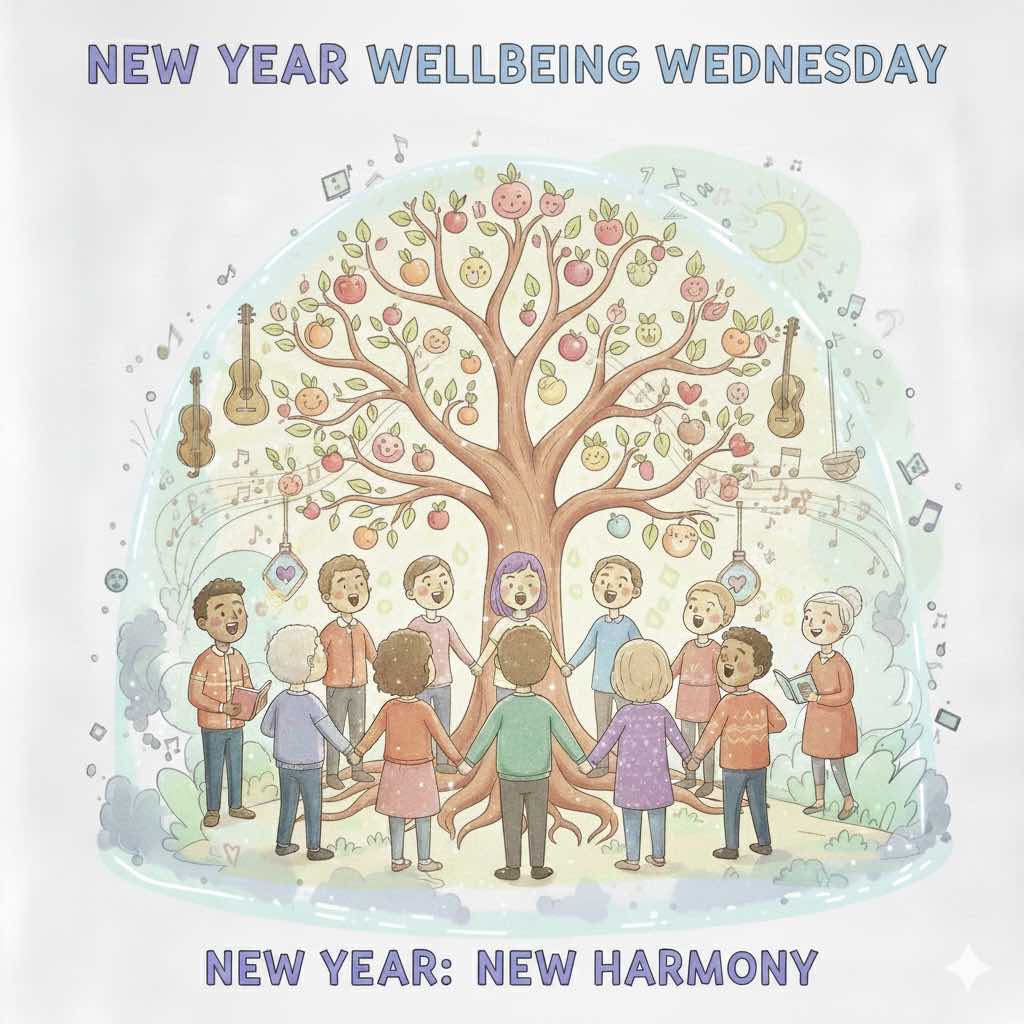
✨ New Year: New Harmony
Welcome to the last Wellbeing Wednesday of 2025! Time is flying.
Every year, around this time, I find myself bombarded with a specific, exhausting message: New Year, New You. A message that hurts my heart, telling us all that who we were yesterday wasn’t quite enough, and that January 1st is the deadline to start fixing yourself.
This year, I’m erasing this message entirely.
There is no “New You” required. You are not a software update that needs installing or a broken machine that needs repairing. You are already whole, resilient, and enough, exactly as you stand today.
Instead of chasing a “new” version of ourselves, let’s talk about a more appealing concept with an aim for a more balanced, supportive 2026: New Harmony.
What is New Harmony?
Harmony isn’t about being perfect; it’s about how different notes sit together to create a pleasing sound. In music, a single note can be beautiful, but it finds its depth when it resonates in harmony with others. (Just ask my choirs about my sandwich analogy! Bread is good, giant sandwich…. more personal and yummy!)
New Harmony is the practice of coming into alignment with yourself, your community, and your surroundings. It’s not about changing who you are; it’s about adjusting the “tuning” of your life so that you feel less friction and more resonance.
Music as the Path to Alignment
Music is the perfect metaphor, and tool, for finding this balance. Here are some ideas for how you can use music to cultivate harmony in your life in 2026:
1. Harmony with Yourself: The Power of Listening
We often use music as background noise to drown out our thoughts. This year, try active listening as a form of self-intimacy.
- The Practice: Carve out time just for you and a pair of headphones. No chores, no scrolling. Just listen to a piece of music that moves you. Let it reflect your internal state. When we listen deeply, we acknowledge our own emotions, bringing our inner world into harmony.
- Engage and process your emotions: Avoid listening to something to “make” yourself happy. Sometimes music can help us to process and move through difficult emotions, if you feel that you need more support with this, please do drop me a message, or contact a music therapist to get support.
2. Harmony with Community: The Joy of Singing
As I talked about in December, singing together is biological magic. It’s the quickest way to feel in sync with the people around you.
- The Practice: Don’t wait for a special occasion. Join a local choir, a community sing-along, or even just sing loudly with your family in the car. When your voice joins others, the “I” becomes “We.” This is social harmony in its purest physical form.
3. Harmony with Your Surroundings: Intentional Creating
You don’t need to be a professional musician to create. Creating sound, whether it’s humming a melody, tapping a rhythm, or learning three chords on a guitar, is a way of interacting with the world around you.
- The Practice: Give yourself permission to play. Creating music is a dialogue between you and the space you inhabit. It turns “noise” into “art” and helps you feel grounded in your environment.
Tuning Your Life
If you feel “out of tune” this January, tired, overwhelmed, or just a bit flat, don’t look for a “new you” try looking for a new harmony instead.
Ask yourself:
- What “notes” in my life are clashing right now?
- How can I use music to soften the edges?
- Where can I find a rhythm that feels sustainable, rather than forced?
Let 2026 be the year you stop trying to rewrite the song of your life and simply start singing it with a bit more resonance. You are the melody; the harmony is simply how you choose to live it.
How are you planning to find your “New Harmony” this week? Will you be listening, singing, or creating? Let us know in the comments.
-
Wellbeing Wednesday: The Sound of Christmas Eve. Finding Harmony Between the Music and the Silence
Welcome to our final Wellbeing Wednesday before the big day. As we stand on the threshold of Christmas, the world can feel like it’s reaching a crescendo. Bells are ringing, Carols are looping, TV shows are blaring, and the frantic energy of “the hustle” is at its peak.
And as the sun sets tonight, we have a unique opportunity to protect our wellbeing by intentionally balancing two of the most powerful tools we have: Music and Silence.
The Music: A Bridge to Connection
Music is the heartbeat of the festive season. On Christmas Eve, it can serve as more than just background noise; it can be a profound emotional anchor.
- Shared Resonance: Music has the power to bridge the gap between our past and present. It taps into that Hiraeth, that nostalgic longing for something, and can transform it into a shared experience of community.
- A Nervous System Reset: High-vibrational, familiar music can actually lower our cortisol levels. Singing along (even if you’re just humming while peeling potatoes!) engages your breath and tells your body: “You are safe. You are home.”
Actionable Tip: Create a “Christmas Eve Sanctuary” playlist. Don’t just let the radio dictate the mood. Choose tracks that feel like a warm hug—songs that ground you and remind you of who you are, rather than the frantic, high-tempo hits that add to the holiday rush.
The Silence: The Gift of the “In-Between”
While music connects us to others, silence reconnects us to ourselves. Christmas Eve is often the noisiest day of the year; not just audibly, but mentally. Our brains are processing to-do lists, family dynamics, and, for many, sensory overload. Silence can be a “palette cleanser” for your wellbeing.
- Processing the Chaos: Silence gives your nervous system a chance to catch up. It’s in the quiet moments (after the kids are in bed, or during a solo walk in the crisp evening air) that we actually process the joy and the stress of the season.
- The Sacred Pause: There is a reason we sing about a “Silent Night.” Silence is where peace lives. It allows us to transition from the “doing” of the lead-up to the “being” of Christmas Day.
Actionable Tip: Practice a “Savouring Silence” block. When the sun goes down on Christmas Eve, find just 10 minutes to sit in the dark with only the tree lights on. No phone, no music, no conversation. Just breathe. Listen to the house settling. Let the quiet settle in you.
The Balance: How to Manage Your Wellbeing
Looking after yourself this Christmas isn’t about choosing one over the other; it’s about knowing when you need which.
- If you feel lonely or disconnected: Lean into the Music. Turn it up, sing loudly, and let the melodies remind you of the communal thread that binds us all together.
- If you feel overwhelmed or “buzzed”: Lean into the Silence. Step into a quiet, preferably uncluttered, room, take some deep breaths, and give your senses a rest from the bells and the glitter.
- The “Switch-Off” Ritual: At a certain point on Christmas Eve, decide that “the work” is done. Switch off the news, put the phone in a drawer, and let the evening be defined by whatever sounds (or lack of) bring you the most peace.
However you spend your Christmas Eve, may you find the perfect rhythm between the joy of the song and the restorative power of the quiet.
Merry Christmas Everyone!
An old recording but the sentiment is the same…. have an amazing Christmas everyone.

-
Wellbeing Wednesday: Reclaiming Your Voice. The Healing Power of Singing
Welcome back to Wellbeing Wednesday. As we move deeper into December, the air is filled with music. But there is a tragedy happening in our modern world that has been worrisome to me and I see in all aspects of my work: we have professionalised something that was always meant to be communal.
We’ve become a society of “listeners” rather than “singers.” We buy the albums, we watch the talent shows, and we compare our voices to autotuned perfection. Somewhere along the way, we started believing that if we don’t have a “good” voice, we shouldn’t use it at all. But what is “good”? Who is to judge a level of “good” when we all have such different tastes?
This Christmas, it’s time to reclaim our voices. Singing together is not about performance; it’s about connection, health, and humanity.
Why Singing Together is Biological Magic
Singing isn’t just a creative outlet; it is a physiological “reset button” for your entire system. When we sing in a group, whether it’s singing with your family or your friends on a karaoke, singing in a choir, or just joining in with a congregation at church, incredible things happen to our bodies:
- The Vagus Nerve Hack: Singing requires deep, controlled breathing, which stimulates the vagus nerve. This instantly lowers your heart rate and shifts your nervous system from “fight or flight” into “rest and digest.”
- The Natural High: Singing releases a cocktail of feel-good chemicals: endorphins (which reduce pain) and oxytocin (the “cuddle hormone” that fosters trust and bonding).
- Heartbeat Syncing: Fascinatingly, studies show that when people sing together, their heartbeats actually begin to synchronize. You aren’t just singing the same song; you are physically becoming one rhythmic unit.
Breaking the “Professional” Barrier
We need to stop asking, “Can I sing?” and start asking, “Am I breathing?” If you have a breath, you have a voice…. and no, you don’t have to magically transform your breat trying to kickstart any involuntary muscles, just relax and trust your bodies instincts.
For centuries, singing was how communities processed grief, celebrated harvest, and bonded through long winters. It was organic, raw, and unpolished. By making singing “professional,” we have inhibited ourselves. We worry about being flat or sharp, but in a community setting, there is no such thing as a wrong note; only a shared one.
When you sing with others, your individual voice blends into a collective “wall of sound.” The pressure to be perfect vanishes, replaced by the sheer joy of vibration and resonance.
Christmas: The Ultimate Season of Song
Christmas provides the perfect “permission slip” to sing. It is the one time of year when the barrier between the stage and the audience disappears.
- A Sense of Belonging: In a season that can feel lonely for many, singing in a group provides an immediate sense of community. You are part of something larger than yourself.
- A Bridge Across Generations: When we sing carols, we are singing the same melodies our grandparents and great-grandparents sang. It is a form of “Hiraeth”; a vocal bridge that connects us to our history and those we’ve lost.
- Physical Vitality: In the cold, dark days of December, the physical act of singing warms the body, expands the lungs, and boosts the immune system.
Your “No-Inhibition” Plan
How can you reclaim your voice this week?
- Ignore the “Critic” in Your Head: That voice telling you you’re “tone deaf” is usually a ghost from a childhood music lesson, or some individual who decided to feel good they would disempower you (believe me, I’ve known them!!!) Silence that voice, speak to yourself as you would your best friend, and remember, your voice is a tool for expression, not a product for sale.
- Join In Loudly: The next time you are at a holiday event, church service, or even a rowdy pub singalong, don’t mouth the words. Let the sound out.
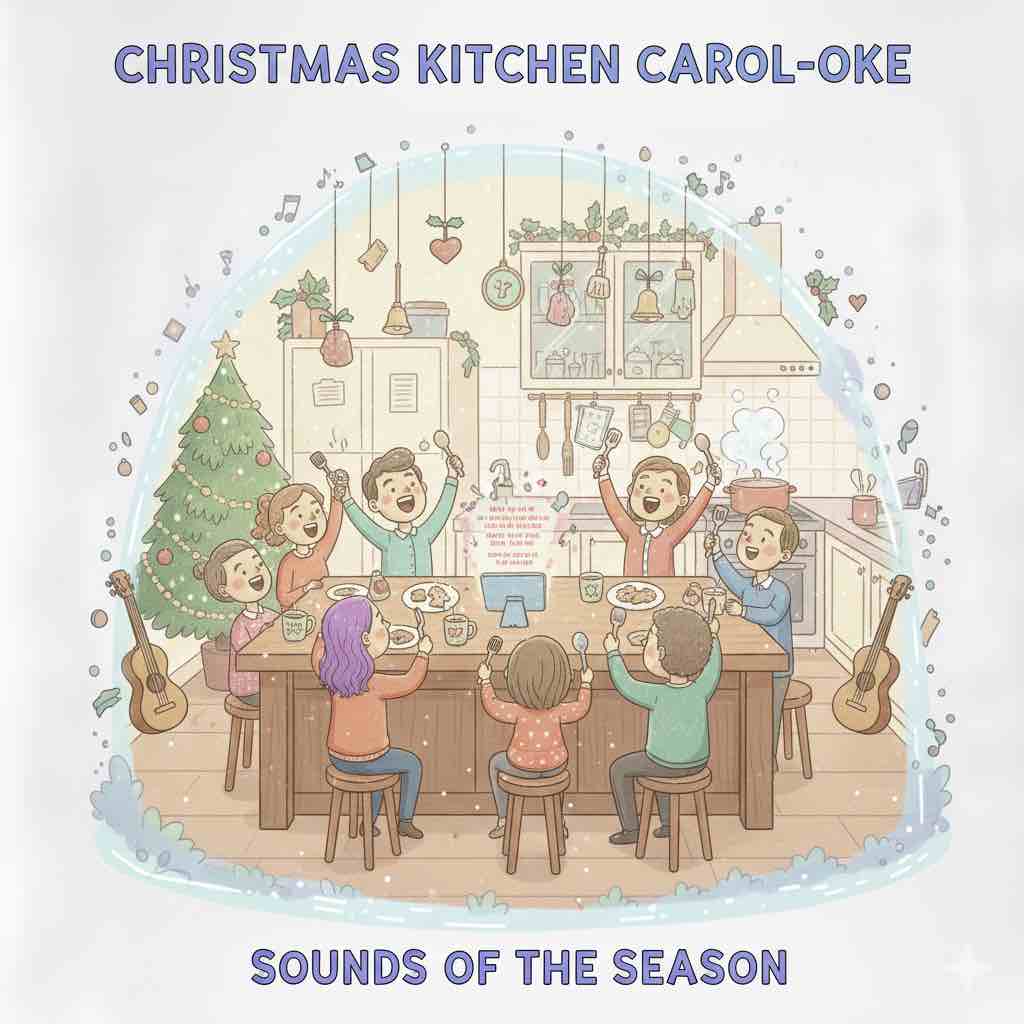
- Host a “Christmas Kitchen Caroloke”: You don’t need a stage. Get family or a friend over and sing while you bake or wrap gifts together.
- Focus on the Feeling, Not the Sound: Notice the vibration in your chest and the way your lungs feel expanded afterward. That physical feeling is the “wellbeing” at work.
This Christmas, let’s stop being spectators of our own culture. Raise your voice, lose the inhibitions, and feel the profound healing that happens when we simply breathe and sing together.
Where is your favourite place to sing during the holidays? Tell us in the comments!
-
Wellbeing Wednesday: Celebrating Chaos Why An Imperfect Family Gathering is Perfectly Perfect
Welcome back to Wellbeing Wednesday! The holidays are nearly here, and everywhere we look, we are fed images of serene, perfectly dressed families enjoying synchronised, peaceful moments.
But let’s be honest usually: Perfection is a myth.
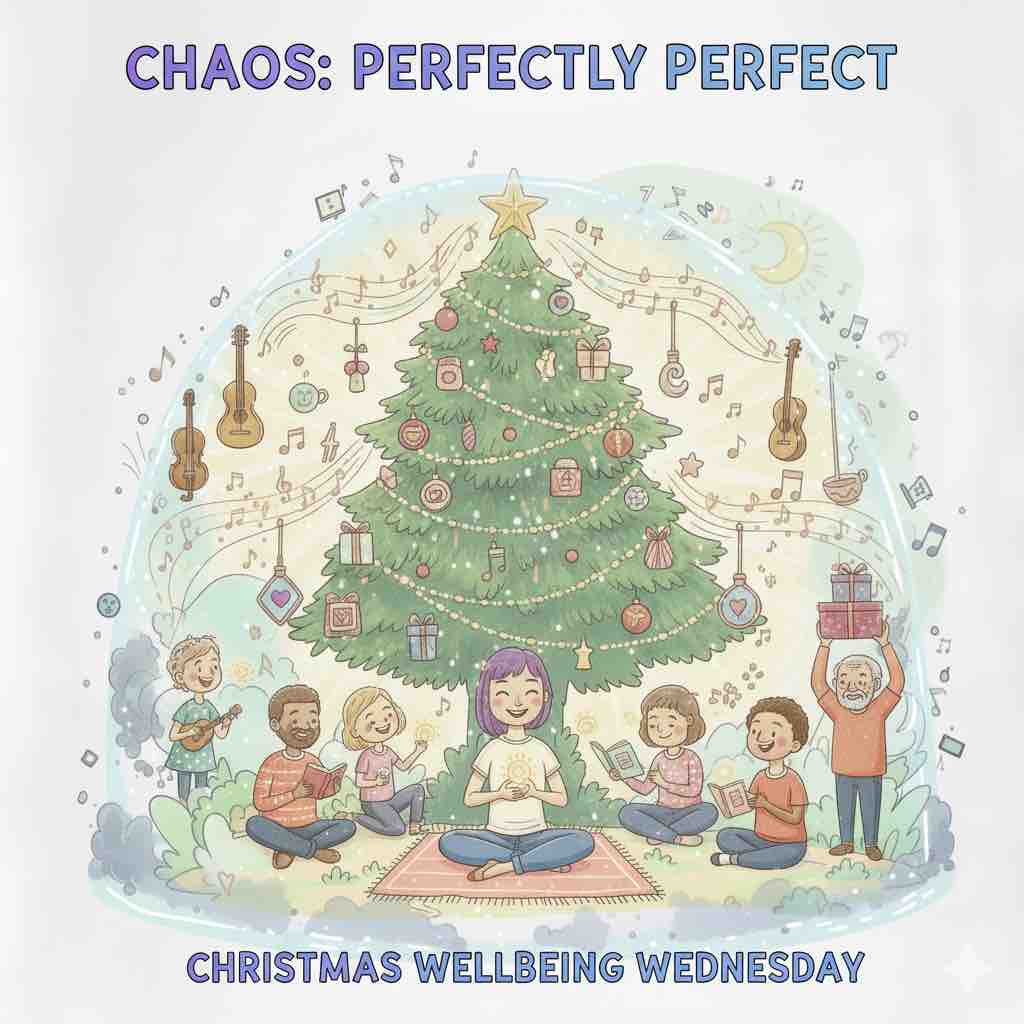
True wellbeing during the holidays isn’t about controlling Great Aunt Edna or ensuring the gravy is lump-free. It’s about recognising that chaos is also perfectly perfect. It’s about lowering the bar so low that you can trip over it, laugh, and focus on the messy, authentic joy of being together.
The Freedom in Letting Go
The greatest source of holiday stress is the relentless pursuit of an ideal that doesn’t exist. When you cling to the idea of a “perfect” gathering, you set yourself up for disappointment and react negatively when reality inevitably intervenes (spilled wine, awkward questions, someone arriving late).
The revolutionary act of self-care this holiday is simply deciding: Nothing has to be perfect.
Here are three ways to swap rigid control for relaxed enjoyment:
1. Embrace the Mess (The Environment)
Stop viewing chaos as a failure and start viewing it as evidence of life being fully lived.
- The Power of the Passable: The house doesn’t need to be immaculate. If it’s safe and there’s a place to sit, it’s done! Clutter is simply a sign that people are busy doing things that matter, like celebrating.
- Dinner Can Be Wobbly: If the centrepiece is a little off-centre, (or you don’t have one) or the kids are eating off paper plates because you ran out of the good plates, that’s fine. Focus on the fact that you gathered people you love and fed them. Nourishment wins over presentation, every time.
- The Unscripted Moment: The moment your carefully planned schedule goes sideways (the turkey burns, the baby screams, the dog steals a slipper), that is the story you will tell next year. Lean into the ridiculousness, take a deep breath, and laugh.
Actionable Tip:
Before guests arrive, look around and identify three things that are “good enough” but not perfect (e.g., the bathroom needs wiping, the lights are tangled, the cookies are slightly burnt). Decide you are letting them go. Your brain will stop nagging you about them.
2. Swap Control for Curiosity (The Interactions)
The moments we usually dread (the probing questions, the political rants) are often only stressful because we feel compelled to fix them or defend ourselves. When you embrace chaos, you remove your responsibility to control other people’s opinions.
- Be a Tourist in Your Own Family: Approach the gathering with genuine curiosity, not judgment. Great Aunty’s unsolicited advice? Just say, “That’s an interesting perspective! I’ll think about that.” (And then don’t.) You don’t have to agree to validate that they spoke.
- Let the Debate Happen (Without You): When a topic you usually dread (like politics) erupts, allow yourself to step out of the ring. You can physically excuse yourself to “check the potatoes” or mentally check out. Tell yourself: “I am observing this dynamic. I do not need to participate.”
- The Joy of the Undefended Self: If someone asks a probing question about your job or life choices, your response can be breezy and boundary-free: “Oh, it’s great! Anyway, tell me about your garden this year.” Change the subject with conviction.
3. Seek Moments of Genuine Connection (The Core Value)
When you strip away the pressure of perfection, you reveal the true purpose of the day: connection.
- Prioritize People Over Tasks: If you have to choose between scrubbing the kitchen floor or spending 15 minutes listening to your grandmother tell a story, choose the story. The connection is the irreplaceable memory; the floor can wait.
- Find Your Anchor: Identify the people who make you feel good…. the person who laughs the loudest, the quiet person who listens well. Spend extra time near them. Use them as an island of calm in the beautiful storm.
- Your Only Job is Presence: You don’t have to be the perfect host or the perfect guest. Your only job is to be present. Be there, be fed, be warm, and appreciate the messy, imperfect, and completely unique group of people you have gathered.
This holiday, let go of the reins. Allow your Christmas to be a little unhinged, a little chaotic, and entirely, wonderfully, and perfectly real.
What is one tradition you are giving yourself permission to skip or mess up this year?
-
Wellbeing Wednesday: Taming the Jingle Bells. Finding Peace in a Season of Sensory Overload
Welcome back to Wellbeing Wednesday! As the Christmas lights go up and the festive carolling starts in earnest, we are entering one of the most exciting (and potentially exhausting…. especially for those musicians among us!) times of the year.
Christmas is a beautiful time of connection, but it is also a relentless period of sensory overload. From flashing lights and loud music to crowded shops and non-stop social demands, our nervous systems begin working overtime.
If you find yourself feeling frazzled, snappy, or inexplicably exhausted by mid-December, you’re not failing at “festive cheer”, you may be experiencing sensory burnout.
The Anatomy of Holiday Overload
Our brains are designed to process sensory information, but during the holidays, the sheer volume, frequency, and intensity of stimuli spike dramatically:
- Visual Overload: Thousands of twinkling lights, bright store displays, metallic wrapping paper, fast-moving crowds……..
- Auditory Overload: Non-stop, often aggressive and loud Christmas music; crowded party chatter; loud children; sirens and traffic……
- Olfactory Overload: The constant presence of strong scents (pine, cinnamon, baking, heavy perfumes) can be overwhelming……
- Social Overload: Back-to-back gatherings and events, forced small talk, and the pressure to perform or bring “joy” can leave our mental battery completely drained.
When our system is constantly bombarded, it can enter a state of perpetual high alert, leading to anxiety, exhaustion, and less capacity to handle even minor stresses. True wellbeing during this time may mean actively managing all of this external noise.
🛑 Finding Your Quiet Corner: Practical Sensory Hacks
Your most important self-care routine in December is creating and enforcing barriers between yourself and the demands of the season.
1. Tips to Manage the Visual Chaos
- Designated “Dark Time”: Schedule at least 30 minutes every evening with the main lights off. Use soft, indirect lighting (lamps, candles) to allow your eyes and brain to rest from the intense visual stimuli.
- Unplug and Look Away: When standing in line at a store, instead of staring at your phone or the chaotic displays, focus on something simple, like the pattern on the floor or the palm of your hand. Grounding your vision calms your central nervous system.
- Curate Your Space: If your home decor is starting to feel overwhelming, put away one cluster of decorations. Less visual clutter equals less cognitive processing.
2. Tips on Taming the Auditory Assault
- The Headphone Shield: Try keeping a pair of noise-cancelling headphones (or even earplugs) in your bag at all times. Use them unapologetically on crowded transport, while shopping, or even when wrapping gifts at home.
- Control Your Soundscape: If you are home, try listening to instrumental music, nature sounds, or simple binaural beats. Give your ears a break from lyrics and sudden noise changes.
- Schedule Silence: Book “Silence Appointments” in your calendar. Whether it’s 15 minutes in your car before heading into work or locking yourself in a quiet room, make silence a non-negotiable part of your day.
3. Try to Prioritize Your Mental Energy (Social Boundaries)
The pressure to say yes to every invitation/event contributes significantly to sensory overload.
- The “One Event” Rule: Limit yourself to one major social event per weekend. If you have two, ensure the second one is extremely low-key (like a quiet coffee, not a massive party).
- The Early Exit Strategy: If you must attend a large event, commit to a strict departure time before you arrive. Tell the host you can only stay for the first hour and then leave when your pre-determined time is up; no guilt necessary.
- Avoid Small Talk Purgatory: When feeling depleted, stick to conversations with people you genuinely like. Deep, meaningful connection is less draining than superficial pleasantries with dozens of strangers.
This Christmas, try to remember that joy and peace are not found in the volume of lights and gifts or the length of your to-do list. They are found in the intentional spaces you create for yourself and your loved ones. Giving yourself and your family the gift of connection is the greatest wellbeing boost you can offer. Simply sitting together listening to gentle, calming music will refuel your connection and help to co-regulate your system.
How are you fighting sensory overload this week? Share your best survival hacks in the comments!
-
Wellbeing Wednesday: The Triple Threat – Juggling Motherhood, Freelance Life, and the Flu
Welcome back to Wellbeing Wednesday. This week, the theme hits incredibly close to home, as I (and I’m sure many of you) have been completely flattened by the flu.
When you’re a freelancer and a parent, getting sick isn’t just an inconvenience; it feels like a very real crisis. The three main roles (Mum, Freelancer, and Patient) are constantly fighting for energy, and when your system is wiped out, that juggling act becomes impossible.
The Unbreakable Rules of the Triple Threat
When the flu or any illness hits, you quickly realize your usual coping mechanisms are useless. You can’t just call in sick because often there is a big event approaching which requires your focus, or only your skill set. And the small people….. well they don’t take a day off either.
Here’s some tips on potential ways to navigate this difficult terrain, focusing on survival, not perfection.
1. Redefine “Productive” (Freelancer Hat Off)
The biggest hurdle for freelancers is the guilt of stopping. When you’re ill, your definition of “productive” must shrink radically:
- Before: Productive means finishing a large project and scheduling five meetings.
- During Flu: Productive means getting fluids down, taking medication on time, and resting for 30 minutes without interruption. That is a win.
Actionable Tip: If you absolutely must do a few minutes of work, choose the most passive task (like simple email sorting or proofreading) and set a timer for 10 minutes. When the timer goes off, stop. Your brain needs the break more than your inbox needs clearing.
2. The Power of Radical Delegation & Solo Survival (Mum Hat On)
This is not the week for wholesome, curated activities. This is the week for survival mode parenting.
- Lower the Bar (Drastically): Dinner can be cereal. Toys can stay on the floor. Screen time limits? They are a suggestion, not a rule. The goal is safety and containment, not developmental milestones.
- The Partner/Village Power: If you have a partner, hand them the reins—completely.
If You Don’t Have a Local Village: I often struggle to accept support from cast memebers, clients, friends, even when it’s offered, something in me says, don’t be a burden, don’t ask too much. But this week has been about learning to lean in to that support and be grateful it is there, regardless of the direction that it has come from. I have been blown away by the many messages of love and support that have come from some very unexpected sources.
Some ideas that we have tried in the past, but I’ve felt too wiped out to even ask for this week have been:
* Virtual Village: Asking a relative or friend video call the kids for 20 minutes to read them a story? Even a quick virtual distraction can provide you with just enough time to take medicine or close your eyes.
* The “Sick Day Kit”: Having a designated box of low-effort, high-engagement activities ready for your children, new-to-them colouring, a forgotten puzzle, or a movie marathon with cozy blankets. This buys you time without requiring your direct involvement.
3. Prioritize the Patient (Patient Hat On)
This is the hardest part for mums and freelancers; prioritizing your own recovery. Your body is staging a small war inside, and it needs resources.
- Communicate, Communicate, Communicate: Immediately contacting clients, students, casts being truthful about the situaiton and your expected return date. This sets an expectation and helps to reduce your stress instantly, it also may have the added benefit, that I have found this week, of eliciting support when it’s most needed.
- Hydration is Your Job: Your primary task for the day is drinking water, staying hidrated. Set a reminder on your phone every 30 minutes to take a sip. Your voice and body need this to heal.
- Use Your Vitals: If your flu symptoms include fever, chills, or deep fatigue, you are not failing by lying down. Your body is demanding rest. Giving in is not laziness; it’s the quickest route back to health and, therefore, back to paid work.
Being ill when the world is depending on you is isolating. Remember: The health of the mother and the stability of the primary income source (you!) are the two most important things. Everything else can, and must, wait.
Sending love to anyone who may need it today. xx
If you are currently sick, please know you are doing enough. What is the one thing you are giving yourself permission to skip this week?
-
Wellbeing Wednesday: The Unplugged Gig – Why Self-Care Is Non-Negotiable for Freelance Performers
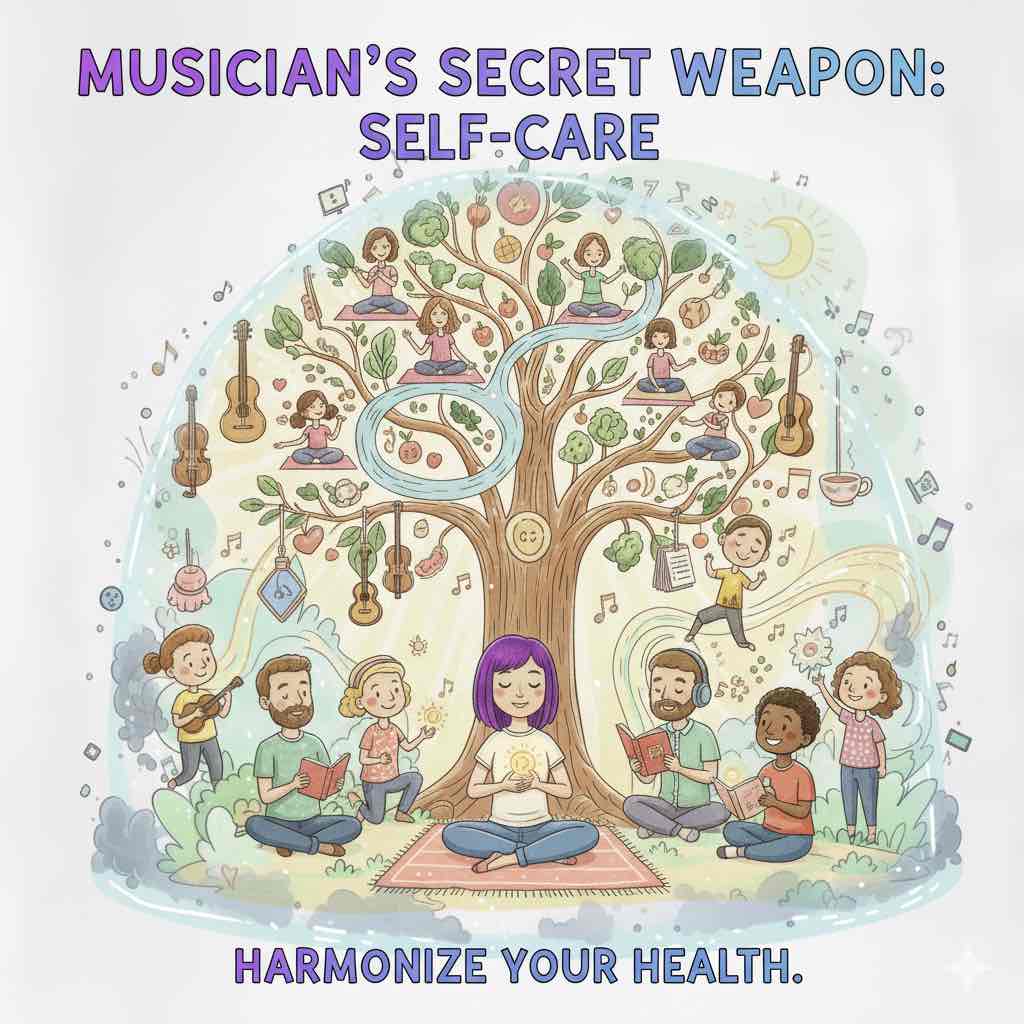
Welcome back to Wellbeing Wednesday! If you are a freelance musician, singer, or performer, you live a life filled with passion, creativity, and the relentless hustle. You are your own CEO, marketing department, and product….. but you are also the instrument.
This week, I’ve been thinking about a concept often seen as a luxury but is, in fact, an absolute professional requirement: self-care for the freelance body and mind. Something I very much struggle to achieve, but I am trying to keep foremost in my mind.
The Unique Hustle of the Freelance Performer
Unlike a salaried job, freelance life is cyclical: bursts of intense performance, long periods of administrative work, irregular sleep, and the constant stress of securing the next gig. For performers, this strain is amplified because your body is your capital:
- Vocalists: Need robust vocal health, managed stress, and proper rest to maintain stamina and range.
- Instrumentalists: Rely on physical endurance, finely tuned motor skills, and freedom from repetitive strain injuries.
- The Mind: Needs focus, emotional resilience to handle rejection, and creative energy to compose and adapt.
When a freelance musician neglects self-care, they aren’t just tired—they are jeopardizing their income and their career.
Why “Powering Through” Is a Failure to Plan
There is a common, toxic narrative in the creative world that “suffering for your art” is necessary. But pushing your body or voice past its limits is not dedication; it is a poor risk management strategy.
1. The Physical Cost: Protecting Your Instrument
For performers, self-care must be specific and physical. It’s about maintenance, not recovery:
- Vocal Health: Hydration, warm-ups, and cool-downs are not optional. A sore throat or laryngitis means cancelled gigs and lost wages. Self-care here is preventative medicine.
- Ergonomics and Repetitive Strain: Hours spent practicing, composing or writing at a desk, editing, marketing, or the physical load of carrying equipment can lead to muscle tension, back pain, or worse conditions. Regular, focused stretching, core work, and timely breaks are essential investments.
- Sleep is Practice: Your brain consolidates motor skills and musical memory during sleep. Pulling all-nighters might seem productive, but it actively undermines your ability to perform accurately.
2. The Mental Cost: Managing the Feast or Famine
Freelance life is a roller coaster, and self-care is the safety bar:
- Handling Rejection: Auditions, grant applications, and booking inquiries often result in rejection. Having clear mental health routines (like a designated “worry time” or meditation) is necessary to keep temporary setbacks from becoming demoralising crises.
- The Isolation Factor: Practicing and composing can be solitary. Scheduling non-work related social time or creative collaborations helps prevent burnout and keeps your mental reserves full.
- Establishing “Off-Time”: Because the office is often your home, it’s vital to create boundaries. Turn off email notifications after a certain hour, or designate a “non-musical” hobby that allows your creative mind to fully unplug. My strategies are leaving my technology (phone, watch and ipad) downstairs at night, limiting my blue light and distractions over night. I also love to read! Anything and everything…. a good book can take you far!
💡 Self-Care Action Plan for the Busy Freelancer
Integrating self-care doesn’t require a whole day off; it requires intentional micro-moments. Try some of these and let me know how you get on.
- The 15-Minute Rule: Before every rehearsal or practice session, dedicate 15 minutes to physical and mental preparation: vocal exercises, focused stretching for your hands/back, or a short breathing exercise.
- The Business of Rest: Schedule rest and recovery blocks into your calendar before you schedule gigs. Treat this time with the same respect you would a paying client.
- Gear Care = Body Care: Invest in lighter cases, walking pads or ergonomic chairs or stands. You can’t perform well if you’ve thrown your back out carrying the equipment.
The most crucial lesson for a freelance musician: You are not a machine. You are a finely tuned instrument. Protecting your instrument is your job. Prioritize the maintenance, and the music will follow.
What small act of self-care are you committing to this week to keep your instrument in tune? Let us know in the comments!